
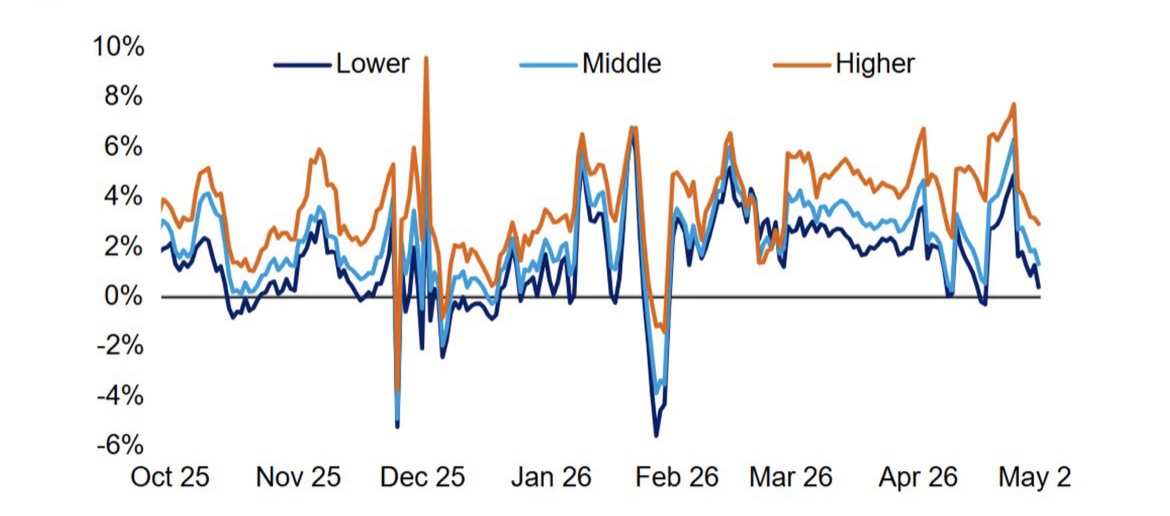
A new wave of economic concern is emerging in the United States after fresh data revealed a noticeable slowdown in consumer spending, one of the most important engines driving the American economy. Recent financial tracking shows that card spending per household declined across most categories last week, signaling growing caution among consumers despite steady employment levels. The downturn affected high-income earners, middle-class families, and low-income households alike, suggesting that the pressure is broad-based rather than isolated to vulnerable groups.
Consumer spending accounts for roughly two-thirds of U.S. economic activity, meaning even small behavioral changes among households can carry significant economic implications. Analysts monitoring real-time credit and debit card data observed reduced purchases in discretionary sectors such as retail goods, dining, entertainment, and travel. The only major exception was gasoline spending, which rose largely due to fluctuating energy prices rather than increased consumer confidence or mobility. Economists interpret this pattern as a sign that Americans are prioritizing essential expenses while cutting back on non-essential consumption.
The slowdown comes after months of weakening consumer confidence. Surveys tracking household sentiment have shown that Americans remain uneasy about inflation, borrowing costs, and long-term financial stability. Although inflation has cooled compared to previous peaks, prices for housing, food, insurance, and services remain significantly higher than pre-pandemic levels. As a result, many households continue to feel financially stretched even when wage growth appears stable on paper. When confidence drops, spending behavior typically follows, as consumers delay major purchases and increase savings as a precaution against uncertainty.
High interest rates are also playing a critical role. The aggressive monetary tightening implemented by the U.S. Federal Reserve to combat inflation has made borrowing more expensive. Credit card interest rates, auto loans, and mortgage costs remain elevated, discouraging large purchases and reducing disposable income. Research consistently shows a strong relationship between consumer confidence and borrowing behavior, with households becoming less willing to spend or take on debt when economic outlooks appear uncertain.
Another concerning element of the latest data is that spending weakness is no longer confined to lower-income groups. During earlier phases of economic tightening, wealthier households continued spending, helping sustain economic momentum. The recent decline among higher-income consumers indicates that financial caution may now be spreading across the entire income spectrum. Economists often view this as an early warning sign because affluent consumers typically drive discretionary sectors such as luxury retail, travel, and hospitality.
Financial markets and policymakers are watching closely because sustained declines in consumer spending could slow overall economic growth in the coming months. Retailers may begin adjusting inventories, businesses could scale back hiring plans, and corporate earnings forecasts may weaken if consumer demand continues to soften. Some analysts believe the United States is entering a “late-cycle” economic phase where growth remains positive but increasingly fragile.
Despite these concerns, the situation does not yet signal an immediate recession. Employment levels remain relatively strong, and household balance sheets are still healthier than during previous downturns. However, the combination of cautious consumers, persistent cost pressures, and elevated interest rates suggests that economic momentum is losing speed. If consumer confidence fails to recover, the recent spending decline could evolve into a broader economic slowdown.
Ultimately, the latest spending data highlights a psychological shift within the American economy. Consumers appear to be moving away from post-pandemic spending enthusiasm toward financial preservation. Whether this trend becomes temporary caution or the beginning of deeper economic stress will depend largely on inflation trends, interest-rate decisions, and the ability of households to regain confidence in future economic stability.
