
Table of Contents
Ayo Fayose’s Controversial Claims: A Closer Look at the Political Drama Unfolding in Nigeria
By Dare Adeleke
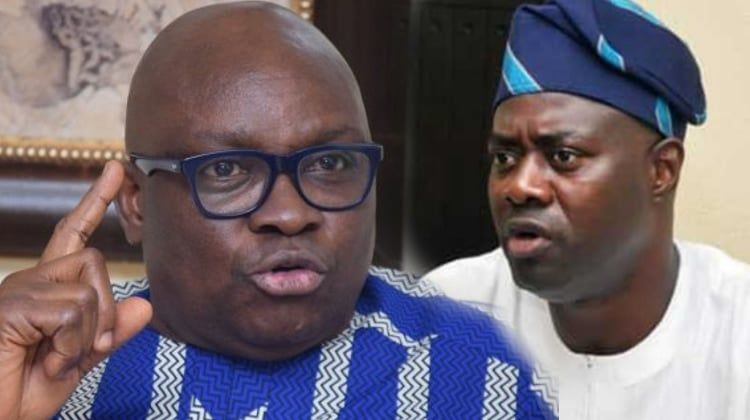
It has become increasingly urgent for those managing Ayo Fayose’s public engagements to reconsider their approach-particularly by ensuring he abstains from alcohol at least a day before any media appearance. The former Ekiti State governor’s recent conduct has been erratic and unbecoming, casting a shadow over the reputation of Ekiti’s citizens. His public demeanor now raises serious concerns about his mental stability, a condition seemingly mirrored by his political allies who have abandoned all decorum and restraint.
Unsubstantiated Allegations Against Governor Seyi Makinde
In his latest media appearance, Fayose, known for his verbose and often inflammatory rhetoric, made baseless accusations against Oyo State’s Governor, Engr. Seyi Makinde. He claimed that Makinde received a staggering ₦50 billion following the tragic Ibadan explosion-a disaster that claimed numerous lives, injured 77 people, and caused extensive property damage. Such a serious allegation, if true, would demand immediate investigation. However, Fayose’s failure to provide any credible evidence reduces his claim to reckless slander.
What makes this situation even more distressing is the timing and insensitivity of Fayose’s remarks. Exploiting a tragedy that left families grieving and communities devastated for political gain is not only unethical but deeply offensive. Fayose’s political career, marked by opportunism and self-interest, appears to have no regard for the human cost behind such events.
The Fallout: Evidence, or Lack Thereof?
When pressed for proof, Fayose’s response was evasive and revealing. He questioned the need for substantiation by comparing his claims to unproven allegations against other political figures, implying that truth is irrelevant in political discourse. This cynical attitude underscores a troubling trend in Nigerian politics where misinformation is weaponized without accountability.
Moreover, the document Fayose presented as evidence was an internal memo requesting funds, not confirmation of any disbursement. Crucially, this memo did not originate from Governor Makinde or the Oyo State Government, but was instead a routine request sent to the Minister of Finance. This glaring discrepancy exposes Fayose’s narrative as a deliberate distortion of facts.
Political Motivations and Public Reactions
Fayose and his associates appear to be driven by jealousy and political rivalry, particularly as Governor Makinde continues to gain prominence within the People’s Democratic Party (PDP) and on the national stage. Their attempts to undermine Makinde through unfounded accusations reflect a desperate bid to regain lost influence.
However, the people of Oyo State remain steadfast in their support for Makinde, whose administration is widely recognized for its commitment to transparency and accountability. The public’s loyalty has rendered Fayose’s smear campaign ineffective, highlighting the importance of credible leadership in Nigerian politics.
Contextualizing the Political Climate
Fayose’s antics are reminiscent of a fading political figure clinging to relevance through sensationalism. His recent behavior, including praising Governor Oyebanji of Ondo State while simultaneously attacking Makinde, suggests a confused and erratic strategy that lacks coherence.
In contrast, Governor Makinde’s steady rise and principled leadership style symbolize a new era in Nigerian politics-one that prioritizes governance over gossip. This dynamic has unsettled Fayose and his cohorts, who resort to spreading misinformation in a bid to destabilize the progress being made.
Call for Accountability and Integrity
The ongoing saga serves as a reminder that political discourse must be grounded in facts and respect for the public’s intelligence. Fayose is hereby challenged to produce verifiable evidence supporting his ₦50 billion claim or face legal consequences and public condemnation. The Nigerian people deserve leaders who uphold truth and integrity, not those who peddle falsehoods for personal gain.
As the 2025 elections approach, the political landscape is becoming increasingly polarized. Yet, the resilience of principled leaders like Governor Makinde offers hope for a future where governance is transparent and accountable. The phrase “GSM to PSM is not negotiable” encapsulates this commitment to progress and unity.
Dare Adeleke reports from Ibadan.
