
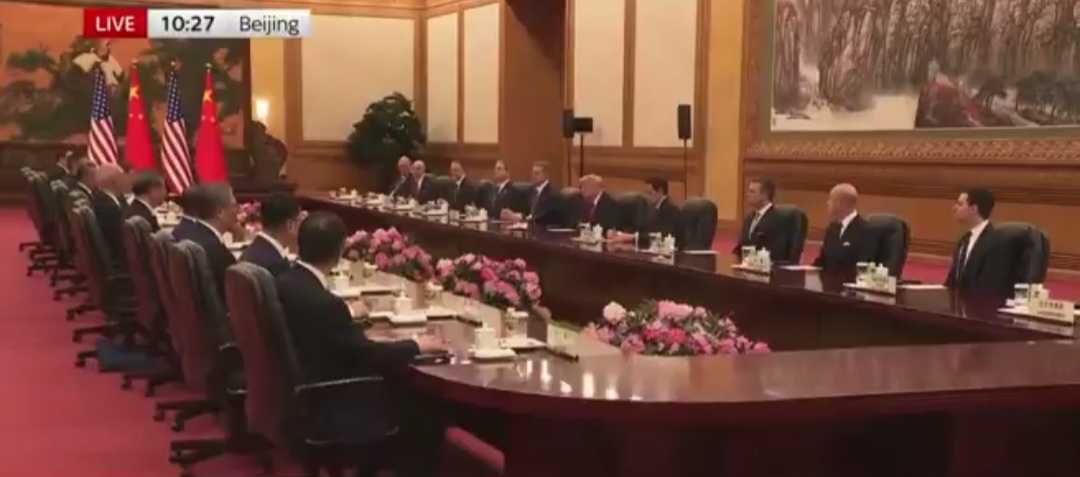
A remarkable diplomatic moment unfolded at a recent global summit when Chinese President Xi Jinping delivered an unexpected message directly to U.S. President Donald Trump, telling the room that the United States and China “should be partners, not rivals.” The statement, delivered before world leaders and senior diplomats, immediately drew global attention because it contrasted sharply with years of economic competition, political friction, and strategic rivalry between the two superpowers.
For much of the past decade, relations between Washington and Beijing have been shaped by trade disputes, technology restrictions, geopolitical competition, and military tension across the Indo-Pacific region. Against that backdrop, Xi’s public choice of words stood out as unusually conciliatory. Rather than emphasizing competition, he framed cooperation as a shared responsibility between nations whose decisions heavily influence global stability, economic growth, and international security.
Observers noted that the remark came at a time when both countries face economic pressures at home and growing uncertainty across global markets. Inflation concerns, supply chain adjustments, and slowing economic momentum have pushed many governments toward stability rather than confrontation. By emphasizing partnership, Xi placed diplomatic cooperation at the center of global leadership expectations, reminding the international community that prolonged rivalry between Washington and Beijing carries consequences far beyond their borders.
President Trump responded positively during the summit exchange, acknowledging the importance of cooperation between the world’s largest economies. The interaction created one of the most talked-about moments of the gathering, as leaders present witnessed an unusually warm public exchange between two governments often portrayed as strategic competitors.
While policy differences remain significant, the moment demonstrated how diplomatic language and public gestures can reshape international conversations. In a world increasingly divided by geopolitical competition, a single statement emphasizing partnership instead of rivalry was enough to dominate global headlines and reignite debate about the future direction of U.S.–China relations.
