
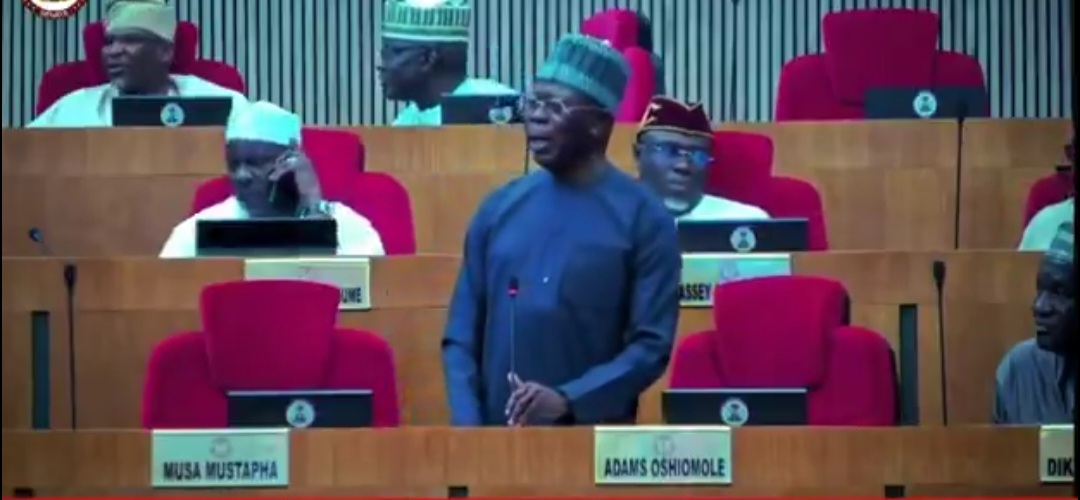
Nigeria and South Africa are once again locked in a heated continental debate after Senator Adams Oshiomhole triggered a political and economic storm with a controversial call for Nigeria to retaliate against South African businesses operating within its borders. The former Edo State governor urged the Nigerian government to revoke the operating licence of MultiChoice Group, owners of DSTV, impose economic restrictions on telecom giant MTN Group, and deliberately replace South African firms with Nigerian-owned companies. His argument was blunt and dramatic: Nigeria’s market power is so significant that decisive economic action would force South Africa’s leadership to reconsider its posture toward Nigerians, insisting that such pressure could make the South African president “fall to his knees.”
The statement immediately exploded across X (formerly Twitter), turning into one of the most discussed political conversations simultaneously trending in Nigeria and South Africa. For many Nigerians online, Oshiomhole’s words captured long-standing frustration over repeated xenophobic attacks against Nigerians living and doing business in South Africa. Supporters argued that diplomatic protests and condemnations have produced little change over the years, and that Nigeria — Africa’s largest consumer market — has continued to provide enormous profits to South African corporations without demanding reciprocal protection for its citizens abroad. To this group, economic retaliation represents not aggression but leverage, a way of converting Nigeria’s population size and purchasing power into political influence.
However, the proposal has also generated strong criticism from economists, policy analysts, and sections of the Nigerian public who warn that such moves could backfire domestically. Critics point out that companies like MTN employ thousands of Nigerians, contribute significant tax revenue, and provide essential communication infrastructure relied upon daily by millions. Likewise, DSTV’s ecosystem supports Nigerian film, sports broadcasting, and entertainment industries. Analysts argue that sudden licence revocations or sanctions could disrupt services, trigger investor panic, and reinforce fears among foreign investors that Nigeria’s business environment may be vulnerable to political decisions driven by diplomatic disputes.
Across South African social media, reactions have been equally intense. Many commentators dismissed the remarks as political rhetoric designed for domestic applause rather than actionable policy, while others warned that escalating economic nationalism between Africa’s two largest economies could damage regional cooperation under continental trade ambitions. The online exchanges quickly evolved beyond Oshiomhole’s statement itself, reopening deeper tensions that have simmered for years — from migration disputes and economic competition to questions of which nation truly holds continental leadership influence.
At the heart of the controversy lies a broader rivalry between Nigeria and South Africa, two economic heavyweights whose relationship has long balanced cooperation with competition. South African multinationals have expanded aggressively across Nigeria’s vast market, while Nigeria’s demographic strength gives it unmatched consumer power on the continent. Oshiomhole’s remarks therefore resonate beyond politics; they tap into a growing sentiment of economic nationalism among Nigerians who increasingly question whether Africa’s largest market should demand stronger reciprocal respect from foreign partners operating within its borders.
Whether the Nigerian government will consider any such drastic measures remains uncertain, but the political impact is already undeniable. The senator’s comments have shifted public discourse from diplomatic complaints to economic strategy, forcing conversations about how African nations should respond to cross-border tensions in an era where corporate presence often carries as much influence as political diplomacy. For now, what began as a Senate remark has transformed into a continental conversation — one exposing the fragile balance between economic interdependence and national pride, and reminding observers that in modern geopolitics, markets can sometimes speak louder than diplomacy.
