
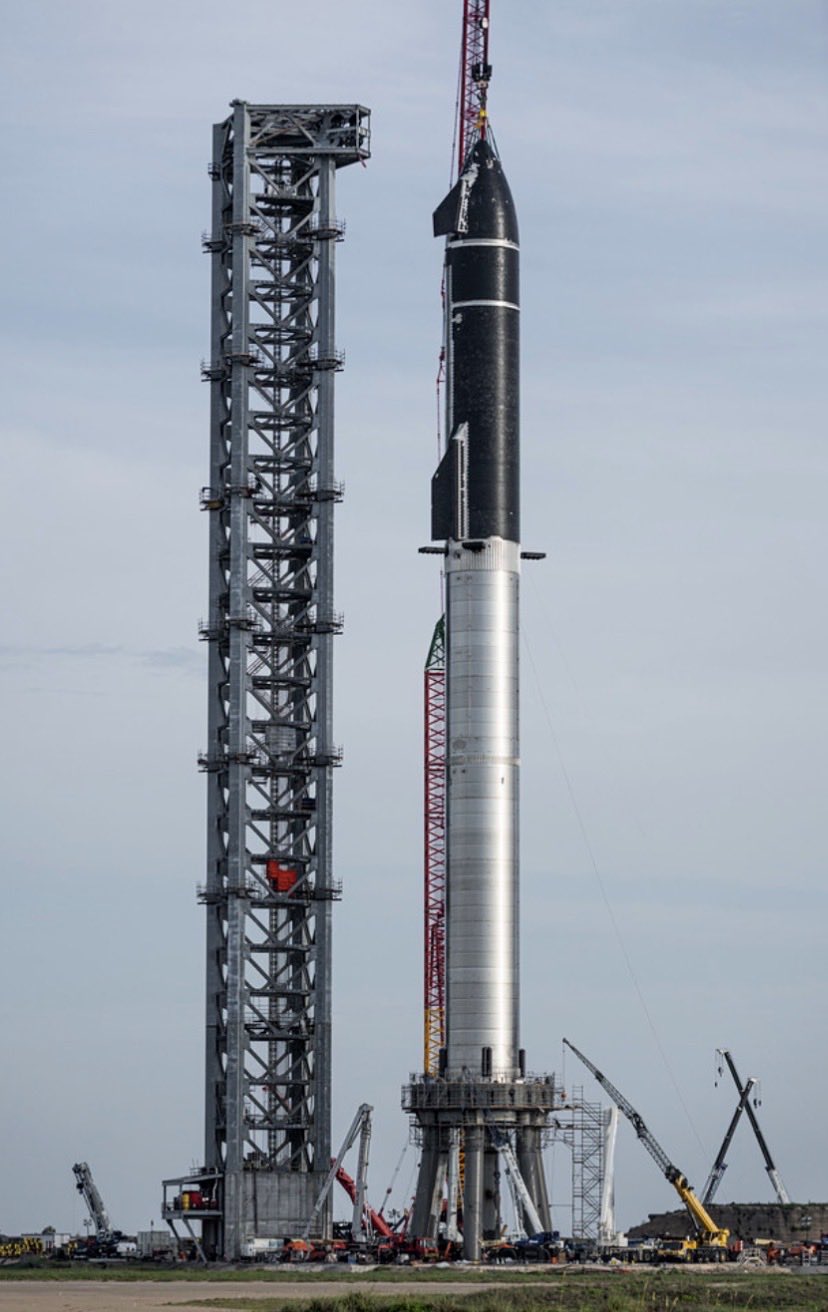
The global space industry witnessed another historic milestone after SpaceX revealed the first fully stacked version of Starship V3, signaling a major leap in humanity’s ambition to travel beyond Earth. The images shared online quickly gained massive attention across social media platforms, with millions viewing what many experts believe could become the most powerful spacecraft ever built.
The term “full stack” refers to the complete assembly of the Starship system — the massive Super Heavy booster combined with the Starship spacecraft itself. This configuration represents the vehicle exactly as it will appear during launch operations. The unveiling of Starship V3 marks an evolution from earlier prototypes, incorporating lessons learned from previous test flights, explosions, and recovery experiments that have defined SpaceX’s aggressive development philosophy.
Unlike traditional aerospace programs that spend years perfecting designs before testing, SpaceX operates on rapid iteration. Each test provides data that feeds directly into the next generation of hardware. Starship V3 is widely seen as the company’s most refined model yet, designed with upgraded structural strength, improved heat shielding, enhanced propulsion efficiency, and faster reusability targets. These upgrades aim to make space travel dramatically cheaper — a core vision long championed by company founder Elon Musk.
The significance of Starship V3 extends far beyond engineering aesthetics. The spacecraft sits at the heart of multiple future missions, including lunar landings under NASA’s Artemis program, large-scale satellite deployment, deep-space cargo transport, and ultimately human settlement on Mars. Space analysts note that the successful stacking of the vehicle indicates SpaceX is moving from experimental testing toward operational readiness.
Online reactions across X (formerly Twitter), Reddit, and aerospace communities reflected growing excitement. Many observers described the full stack as a symbolic moment — the transition from concept to reality. Aviation experts also pointed out how quickly SpaceX has advanced compared to legacy space programs, compressing decades of development timelines into only a few years.
Technically, Starship V3 is expected to support fully reusable launch operations, meaning both the booster and spacecraft could return safely after missions. If achieved consistently, this capability could reduce launch costs by orders of magnitude and open new commercial opportunities such as space tourism, orbital manufacturing, and large-scale scientific missions.
However, major challenges remain. Regulatory approvals, orbital test success, thermal protection durability, and safe crew certification will determine how fast Starship transitions from prototype to routine flight system. Previous test launches demonstrated both spectacular successes and dramatic failures, underscoring the experimental nature of the program.
Still, the unveiling of the first full stack sends a clear message: the next era of space exploration is accelerating. What once felt like science fiction reusable mega-rockets carrying humans toward Mars is steadily becoming an engineering reality. With Starship V3 now standing fully assembled, SpaceX appears closer than ever to reshaping how humanity accesses space and possibly redefining the future of interplanetary travel itself.
