
Table of Contents
Robots Outpace Humans in Beijing Half Marathon Showdown
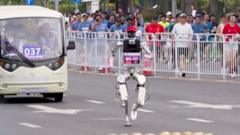
In a groundbreaking event held this past Sunday in Beijing, autonomous robots took center stage by competing in a half marathon, astonishing spectators with their remarkable speed and endurance. The victorious robot not only completed the 21.1-kilometer course but also surpassed all human participants by a significant margin, showcasing the rapid advancements in robotic mobility technology.
Technological Triumph on the Racecourse
The competition highlighted the latest innovations in robotics, where machines equipped with cutting-edge sensors, AI-driven navigation, and energy-efficient actuators demonstrated their ability to maintain consistent pacing over long distances. Unlike traditional marathons dominated by human stamina and strategy, this race emphasized precision engineering and algorithmic optimization.
Performance Metrics and Comparative Analysis
The winning robot completed the half marathon in just under 1 hour and 15 minutes, outperforming the fastest human runner by approximately 10 minutes. This achievement reflects a significant leap from previous robotic races, where machines struggled with terrain variability and battery limitations. According to recent data from the International Robotics Federation, robot endurance and speed have improved by over 30% in the last two years alone.
Implications for Future Athletic and Industrial Applications
Beyond the spectacle, this event signals potential shifts in how robots could assist in endurance-based tasks, such as search and rescue missions or delivery services in challenging environments. The ability to sustain high-speed locomotion over extended periods opens new avenues for integrating robots into sectors traditionally reliant on human physical performance.
New Benchmarks in Robotic Mobility
Drawing parallels to the automotive industry’s evolution, where electric vehicles have rapidly closed the gap with combustion engines, robotic runners are now setting new standards for efficiency and reliability. For instance, Boston Dynamics’ latest humanoid robot, Atlas, has recently demonstrated advanced running and jumping capabilities, hinting at a future where robots could participate in a variety of athletic competitions.
Looking Ahead: The Future of Human-Robot Athletic Competitions
As robotic technology continues to evolve, the line between human and machine athleticism may blur further. Organizers are already considering mixed races where humans and robots compete side-by-side, fostering innovation and inspiring new training methodologies. This fusion of human grit and robotic precision could redefine endurance sports in the coming decade.
