
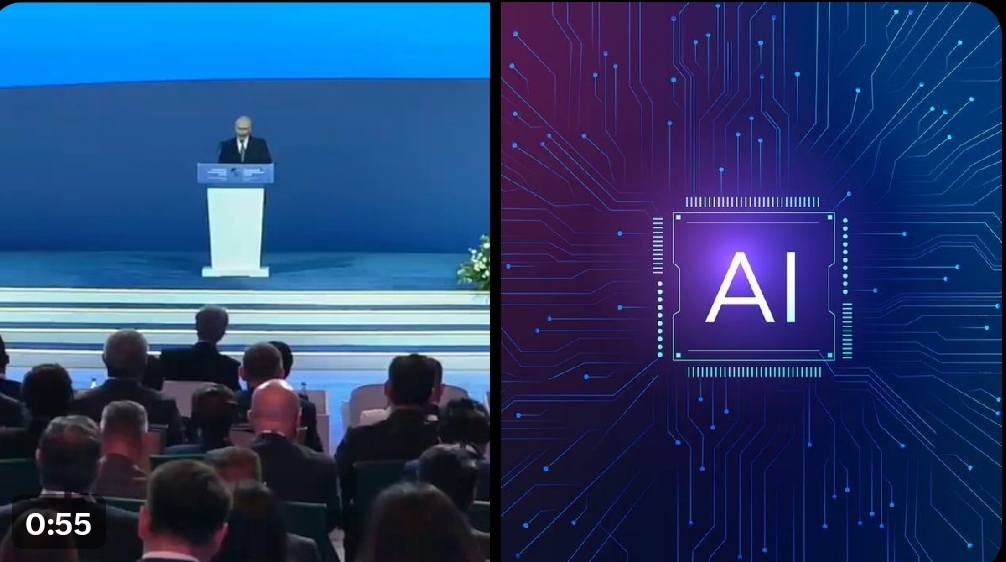
Russian President Vladimir Putin has reignited the global debate surrounding artificial intelligence after declaring that entire professions will disappear and eventually be replaced by AI systems, describing the transformation as both “irreversible” and “inevitable.” His remarks come at a time when governments, technology companies, and workers across the world are increasingly confronting the disruptive impact of automation on modern employment.
Artificial intelligence has evolved rapidly in recent years, moving far beyond simple automation into areas once considered uniquely human. Advanced AI systems are now capable of generating written content, analyzing legal documents, diagnosing medical conditions, producing software code, creating digital art, and even handling customer service interactions with remarkable sophistication. What once appeared to be a distant technological future is now unfolding across industries in real time.
Putin’s comments reflect growing concerns among world leaders that AI may fundamentally reshape labor markets faster than societies can adapt. Economists warn that white-collar professions previously considered secure — including administrative work, data analysis, journalism, accounting, and parts of the legal sector — may face large-scale disruption as companies seek efficiency through automation. At the same time, supporters of AI argue that technological revolutions historically create new industries and opportunities even as older jobs disappear.
The Russian leader’s statement also highlights the intensifying global competition surrounding artificial intelligence development. Nations increasingly view AI dominance as a strategic advantage tied not only to economic growth but also military capability, cybersecurity, intelligence gathering, and geopolitical influence. Countries investing aggressively in AI infrastructure and talent are positioning themselves to shape the next era of global power.
Still, fears surrounding AI-driven unemployment continue growing among ordinary workers. Critics argue that governments have not moved quickly enough to prepare educational systems and labor policies for the coming transformation. Discussions surrounding universal basic income, workforce retraining, and regulation of AI technologies are becoming more urgent as automation capabilities expand at unprecedented speed.
What makes Putin’s warning particularly striking is not merely the prediction itself, but the certainty with which it was delivered. By calling the process unavoidable, he echoed a sentiment increasingly shared across Silicon Valley and global policy circles: that artificial intelligence is no longer an emerging trend but a permanent structural force that will redefine economies, industries, and the future of human work itself.
