
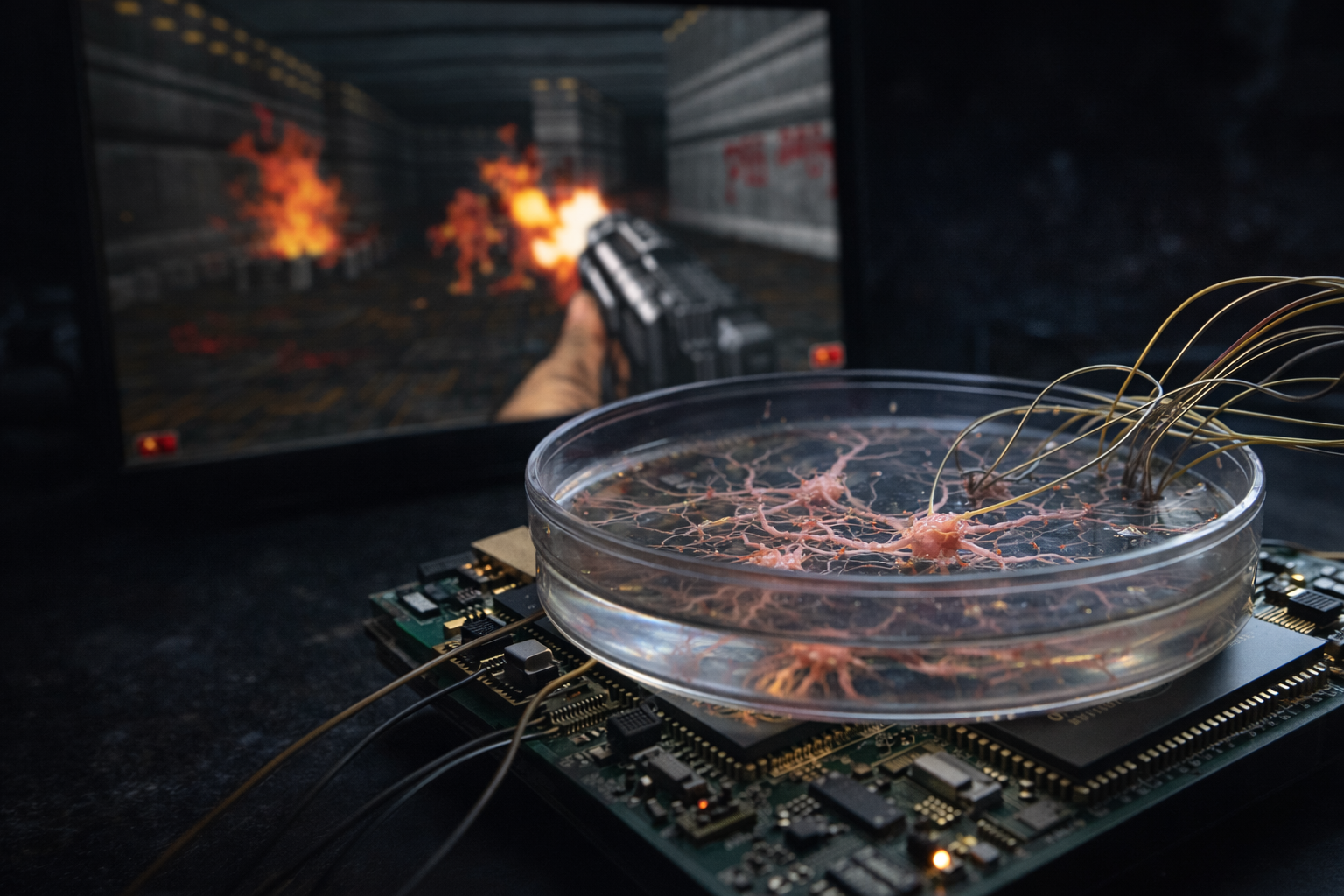
Researchers have reportedly achieved a remarkable technological milestone after human brain cells grown on a microchip learned to play the classic video game DOOM.
The development, which has sparked widespread debate online, comes from advances in biological computing, where living neurons are used as part of computational systems.
According to details circulating on social media, scientists placed about 200,000 human brain cells onto a silicon chip, allowing the neurons to interact with digital signals. Within about a week, the system reportedly learned how to interact with the game environment in DOOM.
The project is connected to Cortical Labs, a company working on what it calls “wetware” computing — technology that combines living biological neurons with traditional computer hardware.
What Is “Wetware” Computing?
Unlike traditional computers that rely solely on silicon chips, wetware computing integrates living brain cells into computing systems.
Developers say these biological systems may offer major advantages over conventional artificial intelligence hardware, particularly in energy efficiency and adaptability.
For comparison:
• The human brain operates on roughly 20 watts of power
• Large AI data centers can require megawatts of electricity
• Some experimental wetware systems reportedly consume far less power than traditional AI clusters
Cortical Labs has reportedly begun shipping early versions of its biological computing systems, sometimes referred to as CL1 units, which are designed to allow researchers to experiment with living neuron-based computation.
The company is also developing a cloud platform that would allow developers to run code remotely on living neurons, effectively offering access to biological computing as a service.
Why DOOM?
Training the neuron system on DOOM is less about gaming and more about demonstrating learning capability.
The classic game is frequently used in artificial intelligence experiments because it requires real-time decision-making, navigation, and environmental interaction — useful tests for adaptive systems.
Researchers say the experiment shows how biological neurons can learn patterns and respond to digital stimuli, potentially opening the door to new types of computing architectures.
Ethical Questions and Future Concerns
The breakthrough has also raised serious ethical questions.
Some experts are asking whether systems built from living brain cells could eventually reach levels of complexity that blur the line between machine and biological intelligence.
Others argue the technology could revolutionize computing, creating systems that are far more efficient, adaptive, and capable of learning than current AI models.
While the technology remains in its early stages, the experiment highlights a future where biological intelligence and artificial computing may increasingly merge.
For now, the fact that living neurons grown in a lab can interact with a video game is already pushing the boundaries of both neuroscience and computer science.
