Table of Contents
Reno Omokri Challenges David Mark on Real-Time Election Result Transmission
Ambassador-designate Reno Omokri has publicly criticized former Senate President David Mark for endorsing the call for real-time transmission of election results in Nigeria. This debate intensified following a press conference held on February 26 in Abuja, where opposition leaders, including Mark, voiced their opposition to the newly enacted electoral law that permits real-time result transmission but also mandates manual tabulation in areas with network failures.
Opposition Leaders Reject New Electoral Law
At the Abuja press briefing, prominent opposition figures such as Atiku Abubakar, Peter Obi, and Rotimi Amaechi joined David Mark in demanding the repeal of the recent electoral legislation. They argued that the law’s provisions for real-time transmission are impractical and called for a return to manual counting methods, especially in regions with unreliable internet connectivity.
Omokri Questions Mark’s Timing and Experience
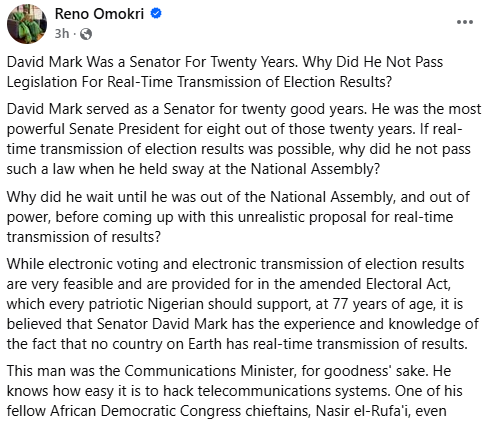
Responding to these demands, Reno Omokri took to Facebook to question why David Mark, who served as a senator for two decades and was Senate President for eight years, never advocated for real-time election result transmission during his tenure. Omokri emphasized that no nation globally currently implements real-time transmission of election outcomes, including countries often cited by the opposition such as Brazil and Estonia.
“David Mark was a senator for twenty years and held the most influential Senate Presidency for eight of those years. If real-time transmission was feasible, why was no such legislation passed under his leadership? Why propose this now, after leaving office?” Omokri asked.
Global Context: Real-Time Transmission Is Not Practiced Anywhere
Omokri highlighted that even technologically advanced countries do not transmit election results in real time. Instead, electronic results are sent only after polls close, with manual voting and transmission as fallback options in case of system failures. For instance, Brazil’s Resolution No. 23.669 (December 14, 2021) explicitly allows manual voting and result transmission to address connectivity and power issues in remote areas.
Similarly, nations like the United States, the United Kingdom, France, and Germany do not employ real-time result transmission. Omokri pointed out that even Amazon Web Services, a leading cloud provider, has experienced significant cyberattacks causing outages, underscoring the vulnerability of electronic systems. He also referenced the fact that both U.S. and Russian military networks, despite their advanced security, have suffered cyber intrusions.
Security Risks and Practical Concerns
Given these realities, Omokri questioned the feasibility of guaranteeing secure real-time transmission of election data in Nigeria, especially considering the country’s telecommunications challenges. He warned that hacking risks could allow malicious actors or foreign entities to manipulate election outcomes, potentially installing a “Manchurian Candidate.”
Omokri also reminded readers that David Mark once served as Nigeria’s Communications Minister and should be well aware of the complexities and risks involved in securing telecommunications infrastructure.
Ensuring Election Integrity Through Party Agents
Omokri concluded by emphasizing that the presence of party agents at every polling unit, who sign the official EC8A forms, is the most effective safeguard against electoral fraud. He suggested that the opposition’s push for real-time transmission stems from their organizational weaknesses in deploying agents nationwide rather than genuine concerns about election transparency.