
An analysis of Sokoto State’s budget execution documents reveals that lawmakers have expended a staggering N4.6 billion on luxury automobiles amidst escalating insecurity and widespread poverty in the region.
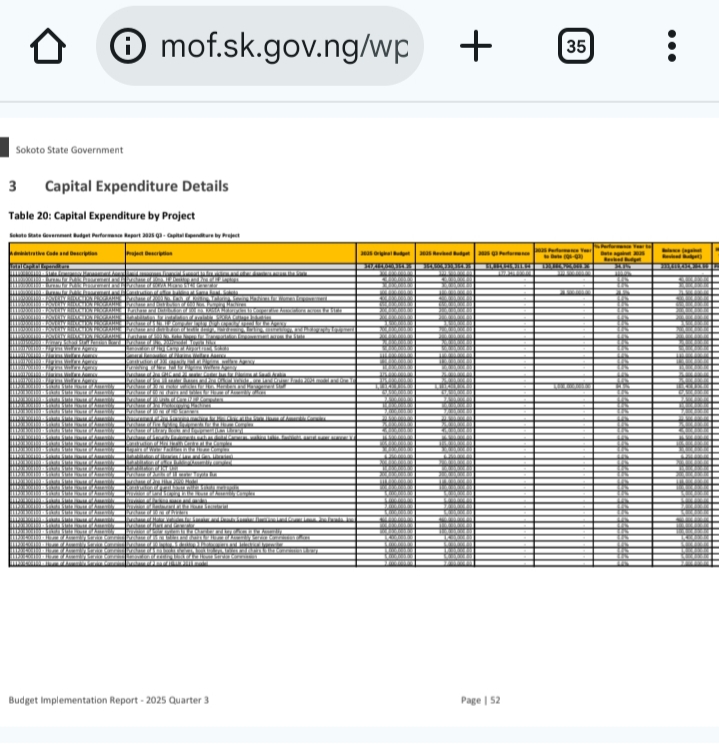
Specifically, from January to September 2025, the state disbursed N1 billion to procure thirty vehicles for House of Assembly members and management personnel, as detailed in the reviewed financial records.
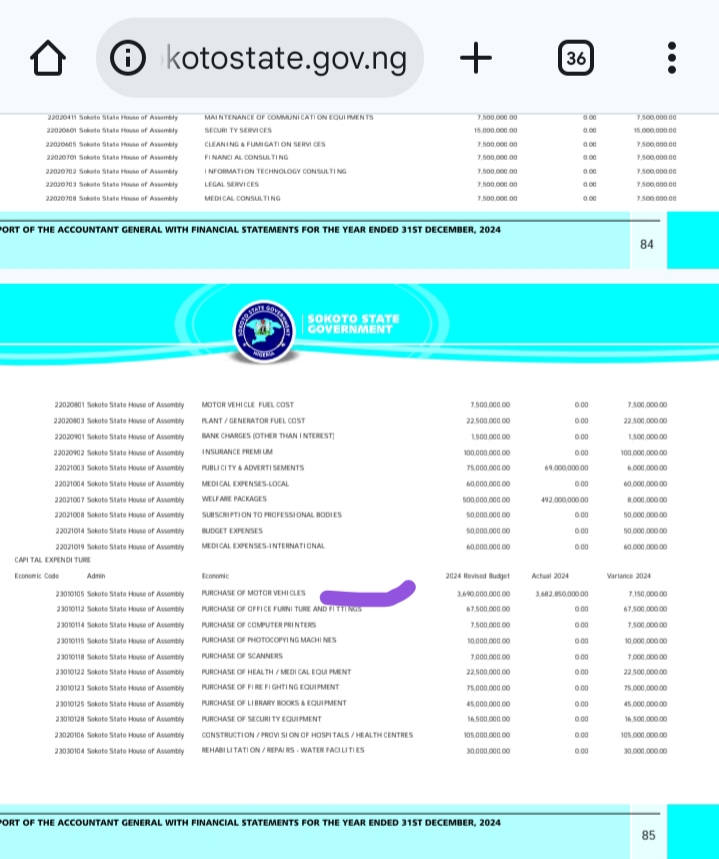
Further scrutiny of the 2024 Accountant-General’s financial statement indicates that lawmakers spent an additional N3.6 billion on vehicle purchases during the 2024 fiscal year.
Combining these figures, the Sokoto State House of Assembly has invested a total of N4.6 billion in vehicle acquisitions between January 2024 and September 2025.
Earlier investigations by SaharaReporters into budget allocations revealed that Sokoto State earmarked a colossal N15.52 billion in 2024 for vehicle purchases intended for House of Assembly members, executive council officials, and special advisers.
The budget breakdown included an estimated N3.1 billion for thirty vehicles allocated to honourable members and management staff. Additionally, N460 million was set aside for the speaker and deputy speaker’s vehicle fleet.
Another N500 million was budgeted for twenty vehicles designated for various government officials.
Notably, thirty executive council members were slated to receive Prado SUVs valued at N8.6 billion, averaging approximately N289 million per vehicle.
Within the first half of 2024, N4.795 billion had already been expended on Prado SUVs, nearly half of the allocated budget.
Furthermore, the budget provided for the acquisition of 40 Changan vehicles for special advisers, with an estimated cost of N2.8 billion. Of this, N2.5 billion was spent in the first six months of the year.
Altogether, political appointees’ vehicle purchases amounted to N7.2 billion in the first half of 2024-comprising N2.5 billion for Changan vehicles and N4.795 billion for Prado SUVs.
These expenditures starkly contrast with the dire socio-economic realities faced by Sokoto’s populace. According to the latest National Bureau of Statistics (NBS) Multidimensional Poverty Index, Sokoto ranks as Nigeria’s poorest state, with approximately 5.81 million residents living in poverty-the highest in the nation.
The data further reveals that 60% of households lack access to adequate sanitation, while 49% do not have clean drinking water. The education sector is equally troubled, with over half (52%) of school-age children out of school.
Civil society organizations emphasize that these figures underscore a profound disconnect between the state’s lavish spending on vehicles for political elites and the urgent, life-changing needs of its citizens.
