
Table of Contents
Erica Nlewedim Opens Up About Repeated Financial Requests After Helping Others
By Linda Ikeji | Published on November 4, 2025, 5:31 PM

Erica Nlewedim, a well-known reality television personality and actress, recently shared her feelings of frustration regarding how her kindness is often exploited by others.
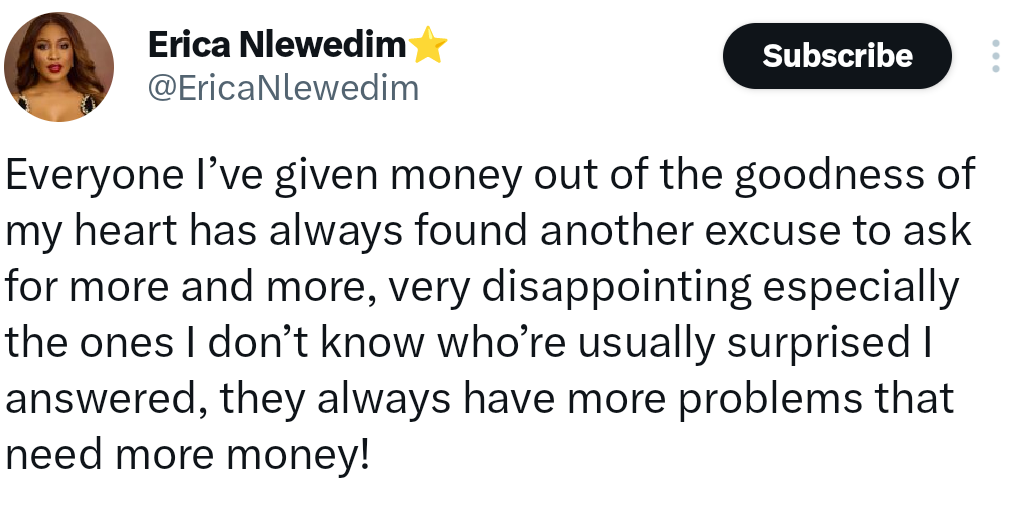
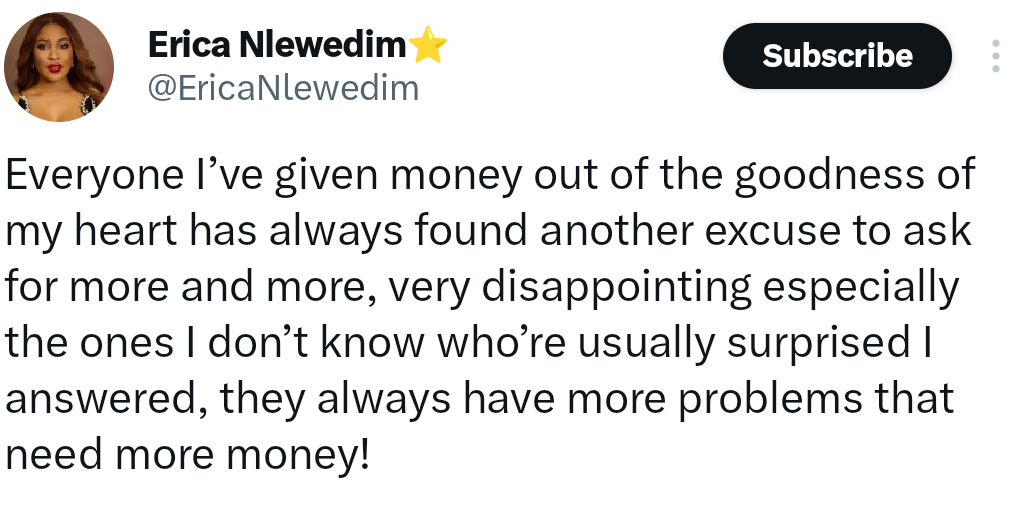
In a candid message posted on X (formerly Twitter), the former Big Brother Naija contestant revealed that every individual she has financially supported out of goodwill tends to return with additional demands.
“Whenever I have extended financial help from the bottom of my heart, it seems to open the door for endless requests. It’s disheartening, especially when strangers, surprised that I responded, come back with more problems needing money,” Erica lamented.
 generosity”>
Public Reactions: The Cycle of Generosity and Entitlement
The star’s post sparked a wave of responses from followers who shared their own experiences with the challenges of giving. Many echoed Erica’s sentiments, highlighting the emotional toll of continuous financial aid without boundaries.
One commenter expressed, “This is exactly my experience. I’ve decided to stop my endless generosity in 2026 because the same people keep coming back with excuses. It becomes a never-ending cycle of helping those who feel entitled.”
Another user shared, “I often give more than requested to cover other urgent needs, but instead of gratitude, it feels like an obligation. They always find new reasons to ask for more money shortly after.”
Others advised setting clear limits, with one person stating, “I allocate a specific budget for charity and stick to it. I prioritize widows, orphans, and young people with clear goals. It’s important to assess the genuineness of requests before giving.”
Setting Boundaries: How to Manage Financial Help Responsibly
Experts and experienced givers recommend establishing firm boundaries to prevent exploitation. According to recent studies, nearly 60% of people who frequently give money report feeling taken advantage of at some point.
Financial advisors suggest the following strategies:
- Budget Your Giving: Allocate a fixed amount monthly or annually for charitable acts to avoid overextending yourself.
- Evaluate Requests: Assess the legitimacy and urgency of each appeal before committing funds.
- Prioritize Recipients: Focus on vulnerable groups such as widows, orphans, and individuals with clear plans for self-improvement.
- Communicate Clearly: Be transparent about your limits to manage expectations and reduce feelings of entitlement.
One commenter shared a personal story illustrating the importance of boundaries: “I helped a friend pay her rent and school fees for years, but when I mentioned my own financial constraints, she still asked for money to buy body cream. That was the turning point for me to reduce my support.”
Community Insights: Navigating Generosity in Today’s World
The discussion around generosity and entitlement is increasingly relevant in today’s economic climate. With inflation rates rising globally, many individuals face financial hardships, which sometimes lead to repeated requests for assistance.
However, as several commenters pointed out, it’s crucial to recognize when help is fostering dependency rather than empowerment. One user advised, “Some people are like leaky buckets; no matter how much you pour in, it never fills. Sometimes, financial education is more valuable than money.”
Others emphasized the emotional strain, recommending that givers protect their well-being by limiting contact with those who exhibit entitled behavior. “Block and cut off communication if necessary. Your mental health and financial stability come first,” one commenter urged.
