
Table of Contents
Contents Overview
Released worldwide on Thursday, November 13, the OnePlus 15 enters the competitive $899 price segment, where top smartphone brands strive to deliver exceptional value. This model distinguishes itself with a robust battery and an ultra-smooth display-features often reserved for pricier devices.
This review benchmarks the OnePlus 15 against other Android flagships within a similar price bracket, focusing on critical aspects such as performance, software longevity, build quality, and overall value retention.
Criteria for Selecting Competitors
With the OnePlus 15’s base price set at $899, we narrowed our comparison to Android flagship phones priced between approximately $720 and $1,080. This range captures the upper mid-tier to premium market, ensuring a relevant and balanced evaluation.
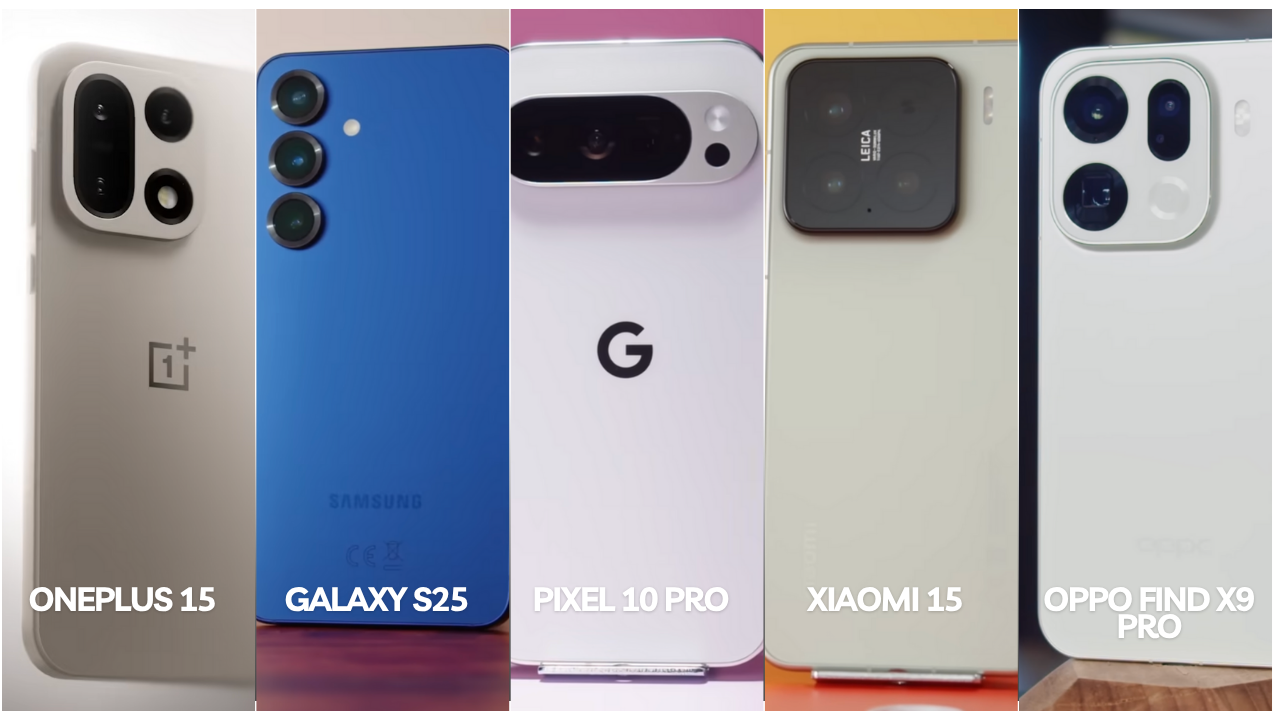
Five flagship models were chosen based on their price proximity and feature sets that resonate with consumers in this segment.
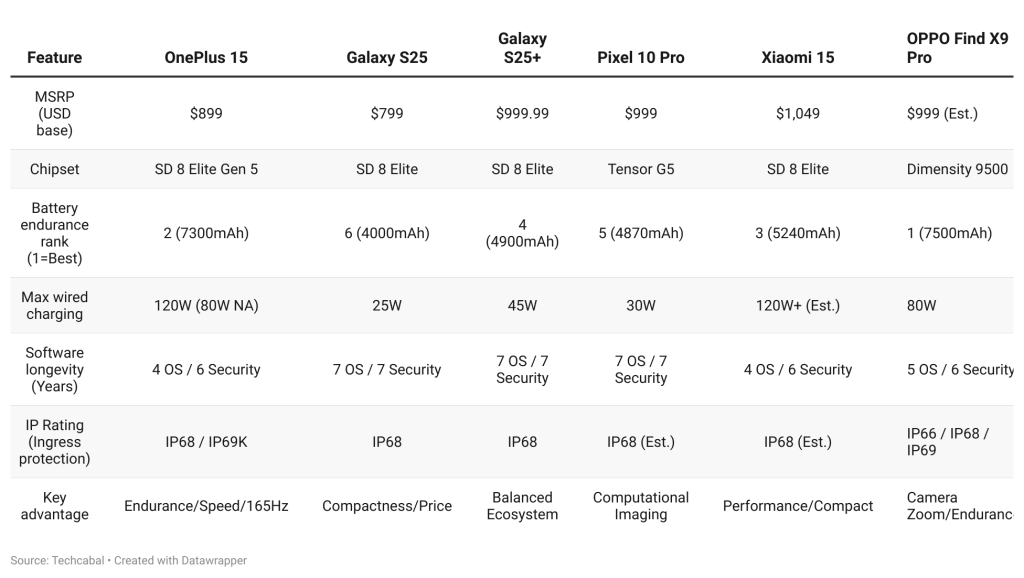
Flagship Comparison Overview
Hardware Breakdown Across Models
Examining the hardware reveals that while all contenders boast powerful processors, they diverge significantly in battery capacity, display technology, and durability features.
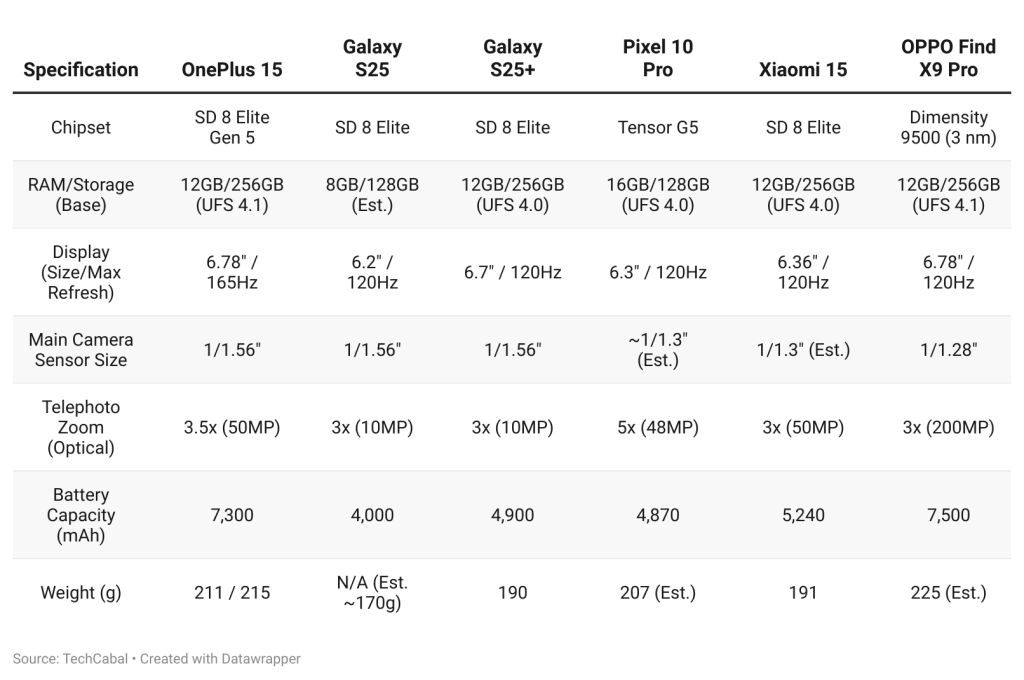
Technical Specifications at a Glance
Processing Power and Display Technology
The majority of these smartphones are powered by the Snapdragon 8 Elite chipset, engineered for peak performance. Exceptions include the Google Pixel 10 Pro, which runs on the Tensor G5, and the OPPO Find X9 Pro, equipped with the Dimensity 9500-each offering unique balances of speed and energy efficiency.
The OnePlus 15 stands out with its expansive 6.78-inch LTPO OLED panel capable of a 165 Hz refresh rate, surpassing the typical 120 Hz displays found on Samsung and Google devices. This elevated refresh rate enhances fluidity in gaming and animations but necessitates a substantial 7300 mAh battery to maintain smooth operation.
Battery Capacity and Charging Speeds
Battery design marks the most pronounced differentiation. OnePlus and OPPO prioritize large batteries paired with rapid charging technologies. The OnePlus 15 houses a 7300 mAh battery, while the OPPO Find X9 Pro pushes this further to 7500 mAh, both utilizing advanced Silicon Carbon battery tech to maximize energy density.
Conversely, Samsung and Google adopt a more conservative battery approach. The Galaxy S25 features a 4000 mAh cell, with the S25 Plus and Pixel 10 Pro offering just under 5000 mAh. Charging rates also vary, with the OnePlus 15 supporting up to 120 W fast charging, significantly outpacing the slower charging capabilities of Samsung and Google models.
Durability and Build Quality
All devices in this comparison meet the IP68 standard for dust and water resistance. However, the OnePlus 15 and OPPO Find X9 Pro elevate durability with an IP69K rating, providing protection against high-pressure, high-temperature water jets-an uncommon feature that underscores their ruggedness.
Real-World Performance Insights
Beyond raw benchmark scores, evaluating sustained performance, thermal management, battery endurance, and camera output offers a more comprehensive picture of daily usability.
Benchmarking and Thermal Efficiency
Devices powered by the Snapdragon 8 Elite-such as the OnePlus 15, Galaxy S25 Plus, and Xiaomi 15-excel in short-term performance bursts. However, the compact Xiaomi 15’s limited internal space restricts cooling, leading to earlier thermal throttling during extended gaming or intensive tasks.
The Pixel 10 Pro’s Tensor G5 chip takes a different route, prioritizing consistent performance over peak scores, especially in AI-driven applications. It maintains near-sustained performance levels comparable to larger Snapdragon-powered phones during prolonged workloads, benefiting users engaged in multitasking or content creation.
Battery Longevity and Charging Efficiency
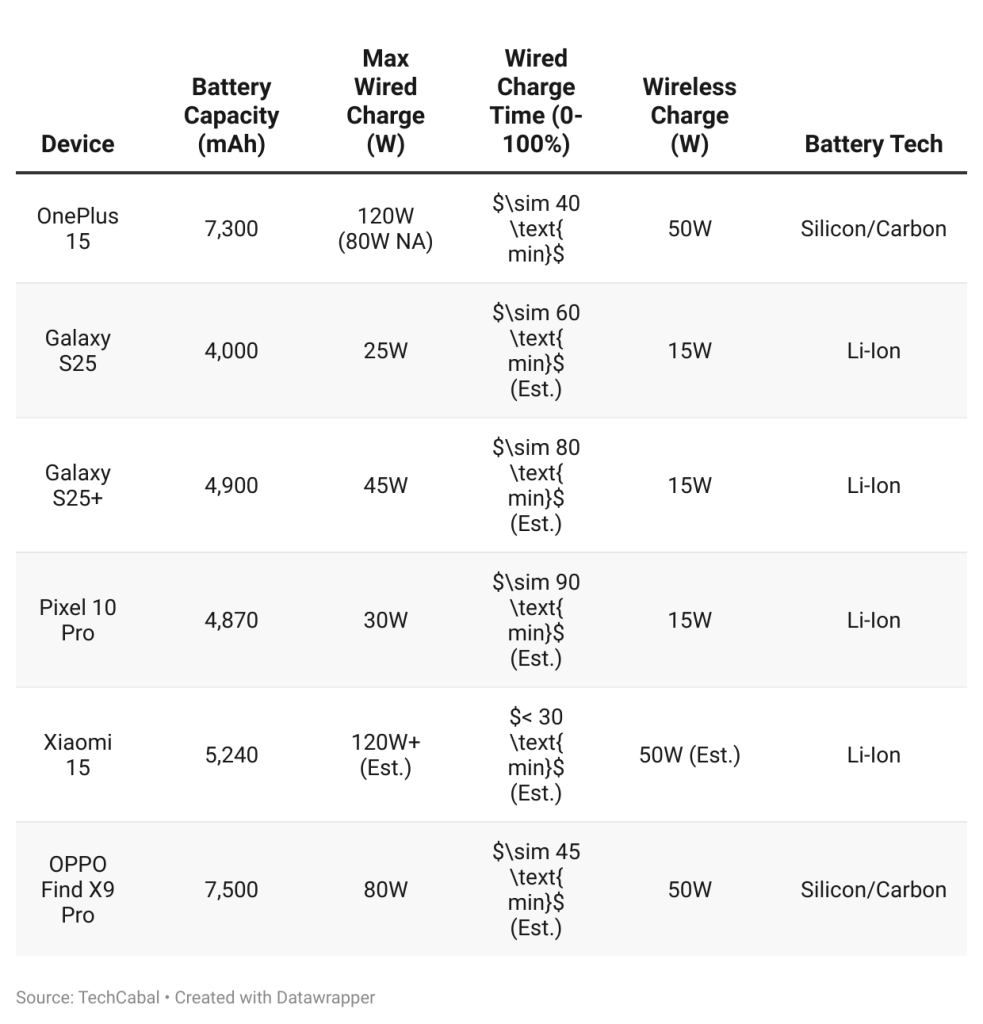
Battery endurance clearly favors the OPPO Find X9 Pro, whose 7500 mAh capacity delivers the longest screen-on time, closely followed by the OnePlus 15’s 7300 mAh battery. Both outperform Samsung and Google models, which remain below 5000 mAh.
Charging speed trends mirror battery size advantages. The OnePlus 15’s 120 W charging capability enables rapid top-ups, outpacing the slower charging rates of the Galaxy S25 Plus and Pixel 10 Pro. Note that in some markets, the OnePlus 15’s charging speed is capped at 80 W, which still remains competitive.
Camera Capabilities and Imaging
Camera strategies diverge notably. OPPO emphasizes large sensors and powerful zoom optics, catering to users who prioritize detailed, long-range photography.
Google relies heavily on computational photography, delivering consistently clean and balanced images with minimal user intervention, despite smaller sensor sizes.
The OnePlus 15 features a triple 50MP camera array paired with a new imaging engine. Initial photo samples are promising, though the ultimate quality will depend on ongoing software refinements from OnePlus.
Long-Term Value and Ownership Considerations
When investing in a smartphone, factors beyond hardware-such as software updates, customer service, and accessory ecosystems-play a crucial role in overall value.
Software Update Policies and Device Longevity
Software support is increasingly vital in this price segment. Samsung and Google lead with commitments to seven years of major Android OS updates and security patches for the Galaxy S25 series and Pixel 10 Pro, ensuring prolonged device relevance and security.
Other manufacturers lag behind: OnePlus and Xiaomi offer four years of major updates and six years of security patches, while OPPO extends OS updates to five years. For users intending to keep their phones beyond three years, Samsung and Google’s extended support provides superior long-term value despite higher upfront costs.
Customer Service and Accessory Availability
Samsung boasts the most extensive global support infrastructure, facilitating repairs and warranty services across numerous countries-ideal for frequent travelers or expatriates.
OnePlus and OPPO primarily focus on regional support, often supplemented by paid protection plans. Warranty service for imported Xiaomi or OPPO devices can be cumbersome outside their primary markets.
Samsung and Google benefit from a vast accessory ecosystem, with numerous third-party manufacturers producing compatible cases, chargers, and mounts. Google’s adoption of the Qi2 wireless charging standard further simplifies accessory compatibility. In contrast, OnePlus and OPPO’s proprietary fast-charging solutions tend to work best within their own product lines.
Pricing Realities and Market Variations
Official retail prices for Samsung, Google, and OnePlus models generally align closely with pre-tax costs in supported regions. Imported devices from Xiaomi or OPPO often incur additional expenses due to customs duties, currency fluctuations, and limited availability, potentially making them pricier in practice despite competitive MSRP listings.
Summary and Recommendations
Your ideal smartphone choice hinges on your priorities-whether that’s battery endurance, camera excellence, software longevity, or balanced performance.
Top Pick for Battery Enthusiasts
- OPPO Find X9 Pro: Featuring a massive 7500 mAh battery and efficient hardware, it outlasts all competitors in this group. The OnePlus 15 is a close contender but falls slightly short in maximum uptime.
Best for Photography Lovers
- Google Pixel 10 Pro and OPPO Find X9 Pro: The Pixel 10 Pro excels at producing clean, share-ready images with minimal effort, while the OPPO Find X9 Pro offers superior zoom capabilities and larger sensors for detailed photography.
Best Value for Longevity
- Samsung Galaxy S25 Plus and Galaxy S25: Samsung’s industry-leading seven-year software and security update policy ensures the longest useful lifespan, making these models cost-effective over time despite slower charging speeds.
Best Overall Performer
- OnePlus 15: Priced at $899, it delivers a compelling combination of high-speed performance, a 165 Hz display, substantial battery life, and rapid charging-offering an excellent balance of features and cost.
Important Trade-Offs to Weigh
Choosing between extended battery life and prolonged software support is key. Devices like the OnePlus 15 and OPPO Find X9 Pro prioritize large batteries and fast charging but offer shorter update cycles. Samsung and Google provide longer software support but with slower charging speeds.
Performance preferences also matter: Snapdragon-powered phones excel in gaming and heavy multitasking, whereas the Tensor G5 chip emphasizes AI capabilities and consistent performance.
Support infrastructure varies widely. Samsung’s global service network contrasts with the more regionally focused support from OnePlus and OPPO, which often rely on bundled protection plans.
Compact models such as the Xiaomi 15 and Galaxy S25 offer easier handling but typically sacrifice battery capacity and thermal management compared to larger counterparts.
