
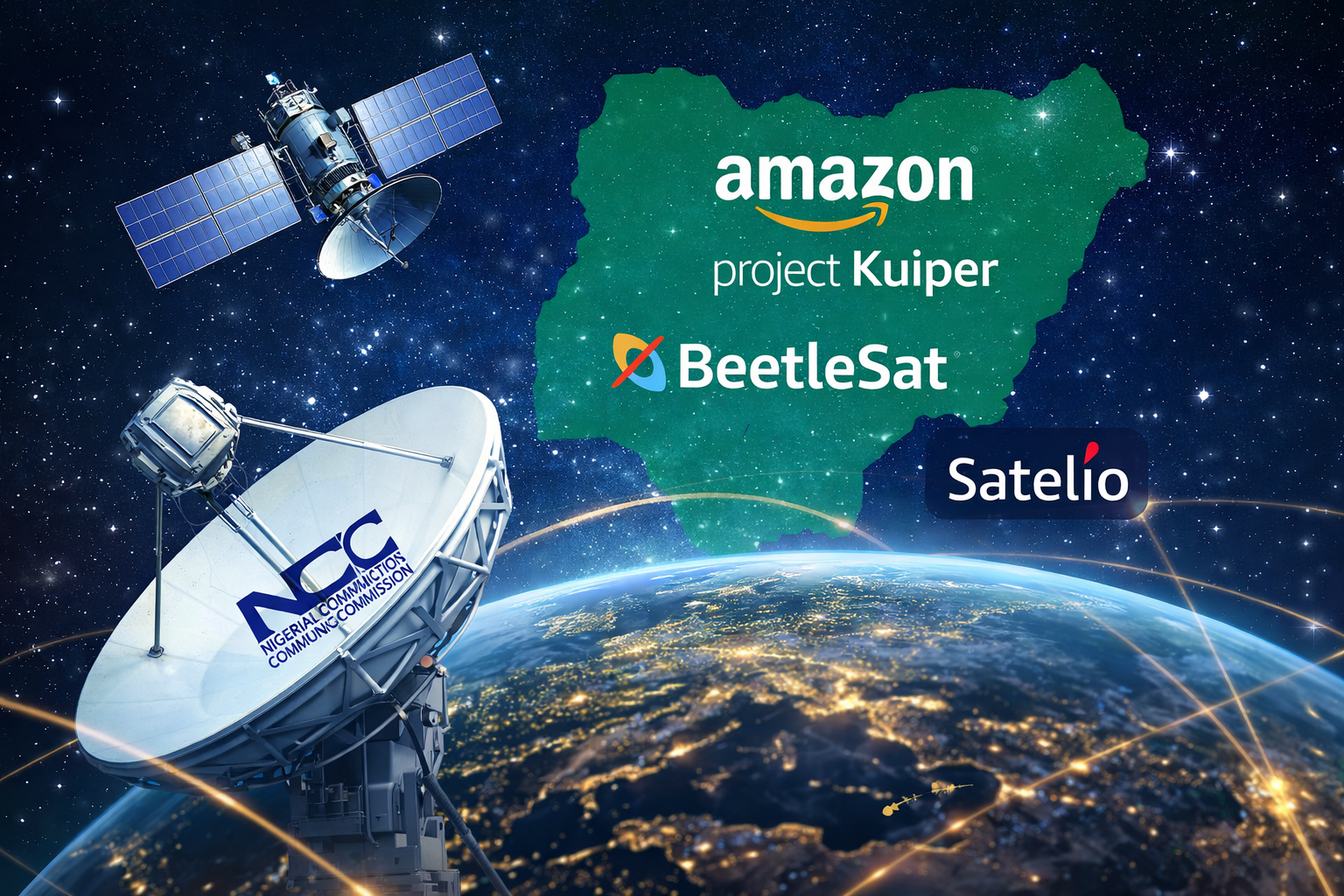
Nigeria has officially granted seven-year satellite operating permits to Amazon’s Project Kuiper, BeetleSat, and Satelio, paving the way for the provision of non-geostationary satellite broadband services in the country from 2026.
The licences were issued by the Nigerian Communications Commission (NCC) as part of efforts to deepen broadband penetration, enhance competition in the telecoms sector, and expand internet access across the country, particularly in underserved and remote communities.
With the approval, the three satellite operators will be allowed to deploy low-Earth orbit (LEO) satellite infrastructure to deliver high-speed internet services nationwide. The move positions them as new competitors to existing satellite broadband providers, including Starlink, which commenced operations in Nigeria in 2023.
According to industry observers, the entry of Project Kuiper—Amazon’s satellite internet initiative—alongside BeetleSat and Satelio is expected to intensify competition in Africa’s largest telecom market, potentially leading to improved service quality, wider coverage, and more affordable pricing for consumers.
The NCC said the decision aligns with Nigeria’s National Broadband Plan, which seeks to achieve universal broadband access by leveraging emerging technologies, including satellite connectivity, to bridge the digital divide between urban and rural areas.
Satellite broadband services are considered critical for regions where terrestrial infrastructure such as fibre-optic cables and mobile base stations are either unavailable or too costly to deploy. The new licences are therefore expected to significantly improve connectivity for schools, healthcare facilities, businesses, and households in hard-to-reach locations.
The seven-year operating window will allow the licensed companies to roll out their networks, build local partnerships, and support Nigeria’s broader digital economy goals, including e-commerce, digital education, and remote work.
With these approvals, Nigeria further strengthens its position as a key market for next-generation connectivity solutions in Africa, as the country continues to attract major global technology and satellite operators seeking to tap into its large and growing digital population.
