Table of Contents
Recent Developments in Venezuela’s Oil Supply to the United States
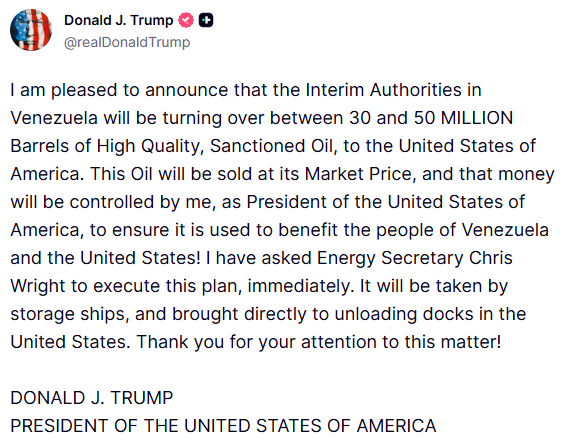
In a bold geopolitical move, former U.S. President Donald Trump revealed plans for Venezuela to export between 30 and 50 million barrels of crude oil to the United States. This initiative follows a military intervention aimed at removing Venezuelan leader Nicolás Maduro from power. The strategy involves newly appointed interim Venezuelan authorities who will oversee the transfer of “sanctioned oil” to be sold at current market rates, with the proceeds managed under U.S. supervision.
Mechanics of the Oil Transfer and Financial Oversight
Trump, via his Truth Social platform, stated that the income generated from these oil sales will be directed to support both Venezuelan citizens and the American public. He underscored that the U.S. government will maintain strict control over the funds to guarantee their appropriate allocation. Energy Secretary Chris Wright has been tasked with expediting the operation, coordinating the shipment of oil through storage tankers directly to U.S. ports for offloading.
Political Shifts and Economic Ramifications
This development marks a pivotal change in the diplomatic and economic relationship between the U.S. and Venezuela, especially amid Venezuela’s ongoing political upheaval. Delcy Rodríguez, formerly Venezuela’s vice president, has been sworn in as interim president during this period of instability. Concurrently, Nicolás Maduro has been apprehended and transferred to the United States to face allegations involving drug trafficking and arms violations.
In an interview with NBC News, Trump emphasized the economic advantages of re-integrating Venezuela as a key oil producer, highlighting its potential to stabilize and possibly reduce global oil prices. This aligns with broader U.S. energy strategies focused on securing dependable oil sources and managing domestic fuel expenses.
Venezuela’s Oil Reserves and Global Market Impact
As of mid-2024, Venezuela boasts the largest proven oil reserves worldwide, estimated at around 304 billion barrels. However, its oil output has been severely constrained by political instability and international sanctions. The planned transfer of 30 to 50 million barrels represents a significant quantity that could affect energy supply dynamics in the region. To put this into perspective, the United States consumes approximately 20 million barrels of oil daily, meaning this shipment could cover U.S. demand for one to two days, offering a short-term boost to energy availability.
Future Prospects and Potential Obstacles
While the initiative promises economic gains, it also presents challenges related to the logistics of transporting large oil volumes, the transparent management of revenues, and the broader political consequences for Venezuela’s governance. The direct involvement of interim Venezuelan authorities and U.S. oversight of funds diverges from conventional oil trade practices, potentially establishing a new model for handling sanctioned resources in conflict-affected regions.