
Table of Contents
Since mid-November, armed criminal groups, commonly referred to as “bandits,” have intensified their violent campaigns across Nigeria’s north-west and north-central zones.
Significant Abductions and Attacks
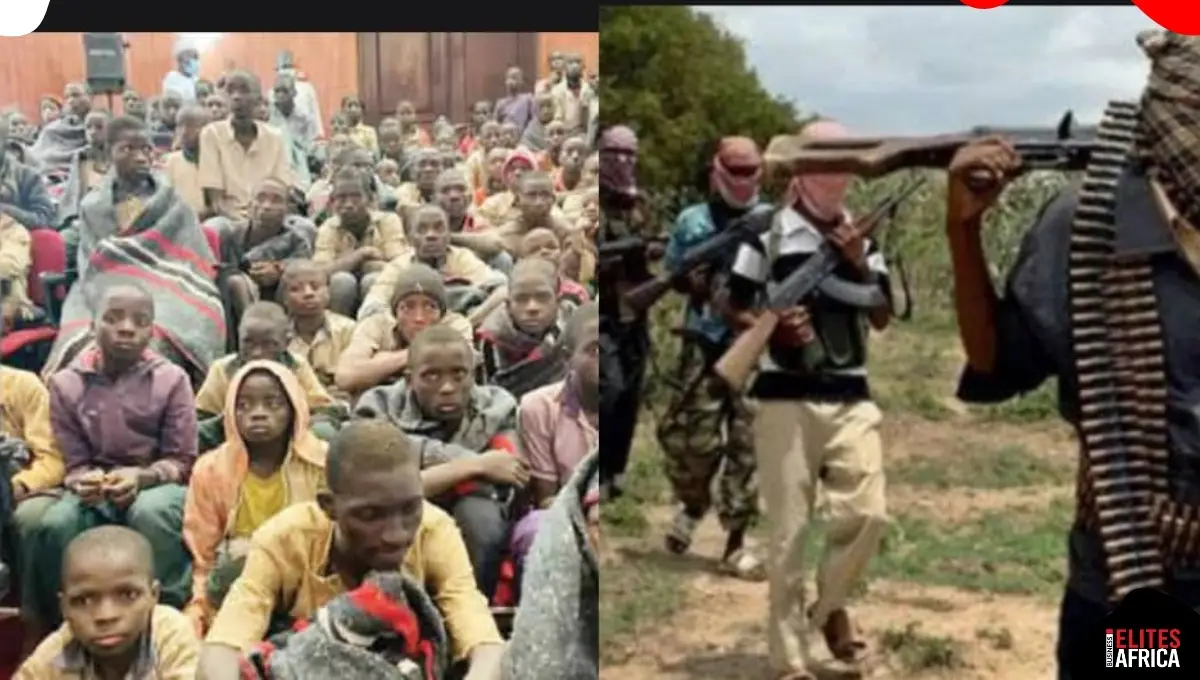
The most devastating abduction occurred on 21 November, when more than 300 students and educators were seized from St Mary’s Catholic schools in Agwara district, Niger State. While approximately 50 captives escaped, many remain unaccounted for.
This tragedy followed closely on the heels of an attack on Government Girls Secondary School in Danko Wasagu, Kebbi State, where 25 schoolgirls were kidnapped and several school officials killed. One student managed to flee, and the remaining 24 were released on 25 November amid widespread speculation of government negotiations with the kidnappers.
Local news outlets have linked these two abductions to the same bandit faction, which has also issued threats targeting military personnel and political figures.
On 23 November, security forces successfully freed 38 hostages abducted from Christ Apostolic Church in Ekuru, Kwara State, five days earlier.
Despite these rescues, violence has persisted, including a deadly attack on 26 November in Niger State that claimed at least 36 lives, alongside multiple kidnappings reported in Sokoto and Kogi States on 30 November.
Religious Persecution Claims Amid Rising Violence
These violent episodes coincide with assertions by former US President Donald Trump, who on 31 October 2025 designated Nigeria as a “Country of Particular Concern” due to alleged religious freedom violations against Christians.
Trump further warned on 1 November of potential US military intervention to protect Christians in Nigeria. However, Nigerian authorities maintain that the unrest affects all religious groups and reject the notion that the conflict is primarily sectarian.
Profiling the “Bandits”
Emerging around 2011, these loosely organized armed groups have entrenched themselves in north-western states including Zamfara, Kaduna, Katsina, Sokoto, Kebbi, and Niger.
Operating mainly from isolated forested regions with minimal government oversight, bandits engage in cattle rustling, armed robbery, kidnappings for ransom, sexual violence, looting, and extrajudicial killings. In some areas, they extort illegal levies from local populations.
The proliferation of small arms, often trafficked from the unstable Sahel region, has significantly empowered these groups.
Unlike ideologically driven insurgents, bandits are primarily motivated by financial gain rather than political or religious objectives. They lack a unified command structure, though certain figures such as Dogo Gide, Ado Aleru, and Bello Turji have gained notoriety for their leadership roles across Zamfara, Sokoto, and Niger States.
In January 2022, the Nigerian government officially classified bandit groups as terrorist organizations, equating them with Islamist militants like Boko Haram and the Islamic State West Africa Province (ISWAP), active around the Lake Chad basin.
Recent intelligence suggests some bandit factions may be collaborating with jihadist groups or adopting extremist rhetoric, complicating counterterrorism efforts.
Government responses have largely centered on military operations, including establishing bases in affected regions, conducting air and ground assaults, and detaining suspects. These actions have displaced some groups into Kwara, Kogi, and Plateau States.
While state authorities support military campaigns, they have also pursued dialogue with select bandit leaders to negotiate peace and reduce violence that has resulted in thousands of deaths and the displacement of hundreds of thousands.
Assessing the Influence of US Statements on Kidnapping Trends
The recent escalation in kidnappings coincides with Trump’s declaration of potential US military involvement to halt what he termed a genocide against Nigerian Christians. Nevertheless, these attacks are not directly attributable to his remarks, as mass abductions have been a recurring issue in Nigeria for years.
For instance, in June 2021, gunmen abducted at least 90 students and five teachers from the Federal Government College in Birnin Yauri, Kebbi State. By mid-2021, reports indicated that over 1,000 students had been kidnapped nationwide due to increasing assaults on educational institutions.
Despite this history, some officials, including George Akume, Secretary to the Government of the Federation, suggested on 17 November that Trump’s statements may have emboldened opportunistic violent groups to target vulnerable civilians and make bold attacks.
While attacks on churches and schools may appear religiously charged, bandits typically select targets based on the potential for lucrative ransom payments. Students and religious congregations are perceived as valuable hostages because families and communities are often able to mobilize funds for their release.
Government Stance on Ransom Payments and Negotiations
In April 2022, Nigeria outlawed ransom payments to criminal gangs, imposing a mandatory 15-year prison sentence for violators. However, enforcement has been limited, with few prosecutions reported.
One notable case involves Tukur Mamu, a controversial preacher and negotiator charged with terrorism for allegedly facilitating a $200,000 ransom payment to free 60 passengers kidnapped from a Kaduna-bound train in March 2022.
Although federal and state governments deny paying ransoms, they have faced persistent accusations of negotiating with kidnappers to secure hostage releases.
Kidnappers frequently publicize ransom payments on social media, showcasing large sums purportedly paid by victims’ families.
Following the release of the 24 schoolgirls in Kebbi State, a video circulated online featuring a gunman claiming the girls were freed after negotiations. Similarly, abductors of the Kwara church hostages reportedly demanded $68,000 per person, though the state government credited security forces for the rescue without confirming any ransom exchange.
Government Actions to Address the Security Crisis
On 26 November, President Bola Tinubu declared a nationwide security emergency, mandating the recruitment of additional military personnel and 20,000 new police officers to bolster security forces.
He also ordered the redeployment and retraining of officers previously assigned to VIP protection, redirecting them to regions severely affected by violence.
President Tinubu has endorsed the establishment of a US-Nigeria Joint Working Group focused on insecurity, with ongoing discussions to enhance bilateral cooperation on security and peacebuilding in northern and central Nigeria.
On 22 November, the United States pledged support for investigations into school kidnappings by providing intelligence assistance and expediting Nigeria’s requests for defense equipment.
Additionally, on 26 November, the Nigerian Senate passed a firearms bill potentially permitting civilians to carry weapons for self-defense, reversing a police suspension on small-arms licenses imposed in August 2023 due to rampant illegal arms proliferation.
The Senate also moved to classify kidnapping as terrorism, amending the Terrorism Act to introduce the death penalty for offenders.
Furthermore, the president has called for a review of existing laws to facilitate the creation of state police forces and urged local governments to reconsider the operation of boarding schools in remote areas amid ongoing security threats.
