
Table of Contents
Allegations of SAS War Crimes Suppression by Former UK Special Forces Leaders
Senior Special Forces Officer Reveals Concealment of War Crime Evidence
A former top-ranking UK Special Forces officer has disclosed to a confidential public inquiry that two previous commanders of the Special Air Service (SAS) deliberately withheld critical evidence pointing to potential war crimes. This officer, identified only as N1466 in the inquiry, testified that in 2011 he presented what he described as “explosive” proof of possible criminal conduct to the then-director of special forces.
He further asserted that the successor director, who assumed command in 2012, was fully aware of ongoing issues in Afghanistan but failed to take appropriate action. According to N1466, the leadership of UK Special Forces was actively engaged in suppressing these serious allegations rather than addressing them transparently.
Failure to Report to Military Police Contravenes UK Law
N1466 confirmed that neither of the two directors reported these grave concerns to the Royal Military Police (RMP), despite legal obligations requiring commanders to notify the RMP if there is suspicion of serious criminal offenses within their units. This testimony is particularly noteworthy as it comes from the highest-ranking former special forces officer to publicly claim that SAS leadership concealed evidence of war crimes.
The Independent Inquiry into Afghanistan, which is investigating these allegations, conducted closed-door hearings where this testimony was given. Due to inquiry confidentiality rules, the names of the implicated former directors cannot be disclosed publicly.
Background: The Afghan Inquiry and SAS Killings
The inquiry was initiated following a 2022 BBC Panorama investigation that exposed allegations of unlawful killings by the SAS during operations in Afghanistan. The report revealed that 54 detainees and unarmed men were killed under suspicious circumstances during a single six-month deployment.
Panorama’s investigation also highlighted that General Sir Mark Carleton-Smith, the director special forces in 2012, allegedly failed to report these war crime allegations. Both Gen Carleton-Smith and his predecessor, Lt Gen Jonathan Page, were named in the inquiry for allegedly neglecting their duty to inform the RMP.
Suspicious SAS Operations and Evidence of Unlawful Killings
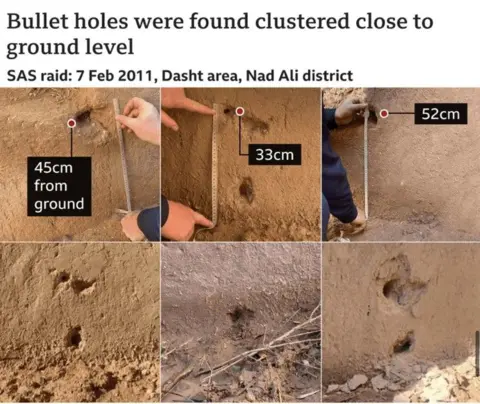
N1466’s concerns began in early 2011 after reviewing SAS operational reports from Afghanistan, which indicated an unusually high number of killings with disproportionately few enemy weapons recovered. One particular night raid resulted in nine Afghan men being killed, yet only three weapons were reportedly found. BBC Panorama revisited this raid site in 2022 and documented bullet holes clustered near the floor, suggesting victims were shot while lying down-contradicting SAS claims of a firefight.
Weapons experts consulted by Panorama concluded that the pattern of bullet impacts was inconsistent with an armed engagement. The victims’ families maintained that those killed were civilians without weapons.
Whistleblower Testimonies and Internal Reviews
N1466 also recounted whistleblower reports of SAS soldiers boasting during training about indiscriminately killing all males of fighting age during missions, regardless of threat level. These accounts, combined with operational data, deeply disturbed him and led him to suspect unlawful killings, including of children.
In April 2011, N1466 commissioned an internal review of recent SAS operations, which revealed alarming findings. He presented this evidence to the then-director special forces, explicitly warning of potential criminal conduct. Despite this, the director chose not to involve the military police but instead ordered an internal review of SAS tactics-a move N1466 described as a superficial attempt to suppress the issue.
The subsequent review was conducted by an SAS officer who only interviewed regiment members and accepted their accounts without independent verification, effectively dismissing allegations of unlawful killings.
Legal Obligations and Delayed Reporting
Bruce Houlder KC, a former director of service prosecutions, emphasized that UK law imposes a clear duty on commanding officers to report suspected crimes, including murder. He stated that failure to report such allegations should have prompted an investigation into the director special forces’ conduct in 2011.
Despite his early concerns, N1466 did not report the evidence to the Royal Military Police until January 2015, nearly four years later and only after the RMP had launched Operation Northmoor, an investigation into SAS conduct. He expressed regret for not acting sooner, acknowledging that earlier intervention might have prevented further unnecessary deaths.
Tragic Consequences and Unreported Incidents
Among the incidents that occurred after the leadership change in 2012 was a raid in Nimruz province where two parents were fatally shot in their bed alongside their infant sons, who were also critically injured. This operation was never reported to the military police.
Responses from Former Directors
The director special forces who assumed command in 2012 has denied the allegations made by N1466, stating he will address each claim thoroughly in his inquiry testimony. He asserted that no senior commanders raised concerns or presented evidence of unlawful killings during his tenure, and that he was unaware of any incidents warranting referral to the Royal Military Police.
The former director in charge in 2011 did not respond to requests for comment.
