
Table of Contents
Rethinking Employment: The African Entrepreneurial Challenge
This morning, I planned to write this article early, but unexpected errands kept me occupied. After a walk through the rainy streets of Accra to get a passport photo-a requirement for registering a generous land gift from an uncle-I finally settled down to share some reflections.
From Corporate Job to Thriving School: A Success Story
Yesterday, I recounted how my cousin left her stable banking career to start a school. Today, that institution educates over 750 students and earns upwards of $40,000 each term. Her journey began seven years ago, and she now enjoys a comfortable lifestyle, traveling internationally to destinations like the United States, the UK, and Germany. Her only regret is not having taken the leap sooner, realizing in hindsight how many years she spent in a job that didn’t fulfill her ambitions.
The Pitfall of Conventional Career Paths in Africa
This story highlights a widespread issue: the heavy dependence on formal employment across Africa. The prevailing mindset-study hard, graduate, and secure a job-has saturated the job market beyond capacity. No government, regardless of efficiency, can create enough positions to absorb the ever-growing pool of job seekers.
Capital Constraints and Misconceptions
Many aspiring entrepreneurs claim that lack of startup capital is their biggest obstacle. Some argue that my cousin’s initial bank salary funded her school, but this is inaccurate. Her income barely covered living expenses. The real seed money came from a $15,000 loan from her partner. While not everyone is fortunate enough to have such support, this example dispels the myth that starting a business requires vast personal savings.
Trust: The True Barrier to Investment
Almost everyone knows someone-whether locally or abroad-with disposable income who could potentially invest in a business. The main reason these potential investors hesitate is a deep-rooted lack of trust. They fear dishonesty or mismanagement, concerns often justified by past experiences. For instance, funds intended for agricultural inputs frequently end up diverted to personal projects like home construction.
Why Banks Demand Collateral: A Reflection of Distrust
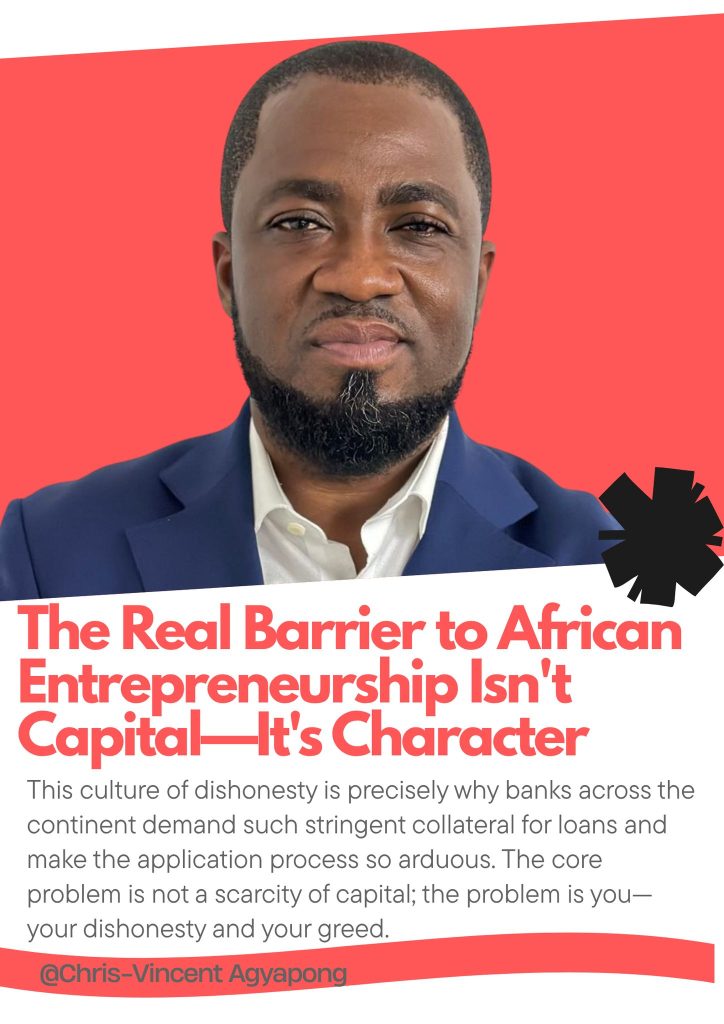
This pervasive culture of mistrust explains why banks impose strict collateral requirements and complex loan procedures. The issue isn’t a shortage of capital but rather the prevalence of dishonesty and greed among borrowers. Even small loans, such as 1,000 GHS via mobile money, are often taken without repayment intentions, reinforcing this cycle of mistrust.
Building Business on Integrity: A Personal Example
Contrasting this, I recently launched a car rental business managing a fleet of seven vehicles-including luxury models like a Range Rover and Nissan Patrol-owned by friends who trust me implicitly. Their confidence stems from my proven integrity; they know I won’t misuse their assets or betray their trust.
The Power of Reputation in Securing Funding
This example underscores a fundamental truth in entrepreneurship: the easiest way to start a business is by leveraging other people’s money. However, such capital only flows to those with a reputation for honesty and reliability. Unfortunately, many aspiring entrepreneurs are perceived as untrustworthy, which is why they struggle to secure financial backing even from close relations.
Integrity: The Most Valuable Asset for African Entrepreneurs
In Africa, starting a business often means capital disappears quickly, accompanied by excuses and broken promises. The real challenge isn’t raising funds-it’s maintaining credibility. If I were to start a new venture tomorrow, I could easily mobilize significant resources from my network because they trust me to manage their investments responsibly.
Capital is accessible for sound business ideas, but the scarcest and most precious resource remains integrity.
