
Table of Contents
Top U.S. Military Delegation Visits Kyiv to Explore Pathways for Ending the Ukraine Conflict
A high-level delegation from the Pentagon has arrived in Ukraine to engage in discussions aimed at resolving the ongoing war with Russia, according to official U.S. military sources. The team, led by U.S. Army Secretary Dan Driscoll, is scheduled to meet with Ukrainian President Volodymyr Zelensky upon his return from Turkey.
Emerging reports suggest that behind-the-scenes negotiations between the U.S. and Russia have produced a tentative peace framework, which reportedly includes significant compromises from Ukraine. However, neither Washington nor Moscow has publicly acknowledged these developments.
Tragically, on the same day as the delegation’s arrival, a Russian missile and drone strike targeted the western Ukrainian city of Ternopil, resulting in at least 26 fatalities, underscoring the ongoing volatility of the conflict. Russia’s full-scale invasion of Ukraine began in early 2022 and has since caused widespread devastation.
Details of the U.S. Military Delegation and Their Mission
Colonel David Butler, spokesperson for the U.S. Army, confirmed that Secretary Driscoll and his team arrived in Kyiv on a fact-finding mission to confer with Ukrainian officials about potential avenues to end hostilities. Accompanying Driscoll are several senior military leaders, including General Randy George, Chief of Staff of the U.S. Army; General Chris Donahue, commander of U.S. Army Europe; and Sergeant Major Michael Weimer.
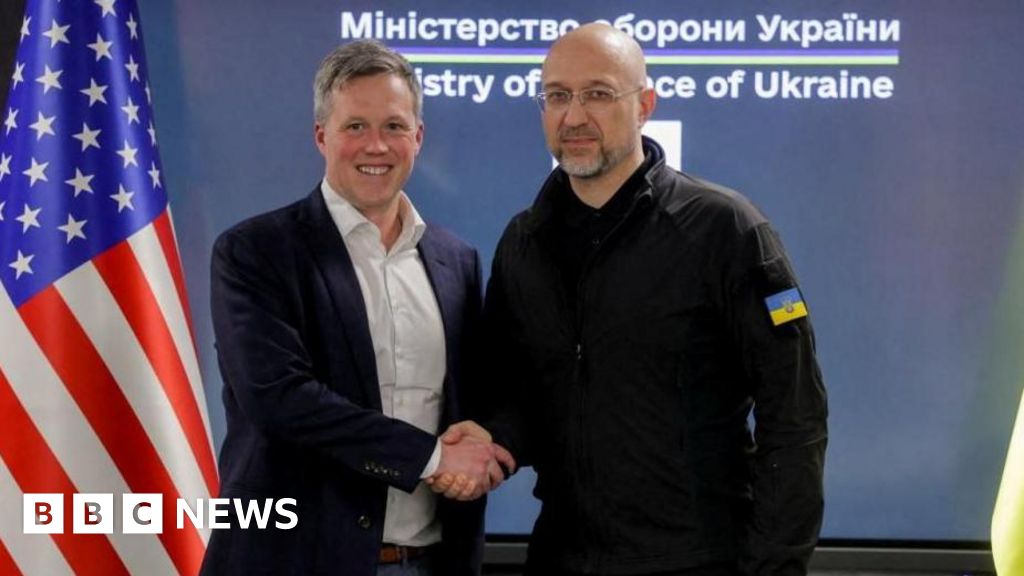
This visit marks the highest-level engagement by U.S. military officials in Kyiv since the inauguration of former President Donald Trump in January 2017. Photographs from the visit show Driscoll shaking hands with Ukrainian Defense Minister Denys Shmyhal, who later highlighted on social media the focus on advancing the defense agreements previously established between Presidents Zelensky and Trump.
Shmyhal also expressed gratitude for the U.S. approval of a $105 million support package for the PATRIOT air-defense system, a critical asset for Ukraine’s defense capabilities.
Focus of Discussions: Military Situation and Ceasefire Prospects
An anonymous Ukrainian official speaking to CBS News, the BBC’s U.S. media partner, indicated that the delegation’s talks would center on the current military dynamics and explore the feasibility of a ceasefire. The official noted that Presidents Zelensky and Trump had previously agreed on halting combat along existing front lines and discussed security guarantees for Ukraine.
Meanwhile, multiple news outlets, including Axios, the Financial Times, and Reuters, have reported that the U.S. and Russia have quietly drafted a 28-point peace proposal. This plan reportedly involves Ukraine relinquishing certain territories and military assets, alongside a substantial reduction in the size of its armed forces. The initiative is said to have been developed with input from Trump’s special envoy Steve Witkoff and Russian envoy Kirill Dmitriev.
Requests for comment from the White House and representatives of Witkoff remain unanswered. Kremlin spokesperson Dmitry Peskov downplayed the reports, referencing the “spirit of Anchorage” – a nod to the 2020 summit between Putin and Trump in Alaska – and stating there were no new developments beyond that framework.
Challenges to Peace: Territorial Integrity and Preconditions
Despite ongoing diplomatic efforts, President Zelensky has consistently rejected any territorial concessions to Russia. Kyiv, supported by Western allies including the U.S., continues to call for an immediate ceasefire along the extensive front lines. However, Moscow has dismissed these calls, reiterating demands that Ukraine views as tantamount to surrender.
Russian Foreign Minister Sergei Lavrov recently reaffirmed Moscow’s preconditions for peace, which include Ukraine ceding territory, imposing strict limits on its military size, and adopting a neutral status. These conditions mirror those outlined by President Putin months before the invasion commenced.
Leadership Changes and U.S. Policy Outlook
In related news, a White House official confirmed that Keith Kellogg, the U.S. special envoy to Ukraine, will step down from his position in January. Kellogg’s departure is reportedly due to the expiration of his Senate-approved term, which cannot extend beyond 360 days without renewal.
Kellogg has been recognized as a key advocate for Ukraine within the White House, particularly during periods when former President Trump appeared to adopt a more Russia-friendly stance. His exit may signal shifts in U.S. diplomatic engagement as the conflict continues to evolve.
