

Table of Contents
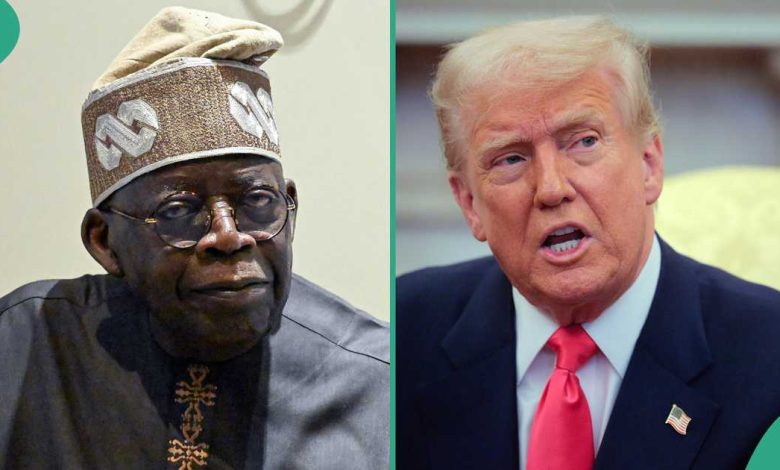
Presidency Announces Timeline for Trump and Tinubu to Address Bilateral Tensions
In the wake of recent threats from the United States government concerning alleged targeted violence against Christians in Northern Nigeria, the Nigerian presidency has disclosed when Presidents Donald Trump and Bola Tinubu are expected to reconcile their differences.
Daniel Bwala, Special Adviser on Policy and Communication to President Tinubu, emphasized on Sunday that both leaders have historically aligned on counterterrorism efforts, not only within Nigeria but on a global scale. He highlighted that both presidents acknowledge terrorism as a grave violation of human rights.
Bwala noted that President Trump has supported Nigeria through various means, including approving arms sales to Africa’s most populous nation, thereby bolstering its capacity to fight insurgency.
Progress Under Tinubu’s Leadership
On his part, President Tinubu has capitalized on these opportunities, demonstrating a firm dedication to eradicating insurgent threats. This commitment is reflected in the Nigerian military’s recent operational successes against terrorist groups.
“President Tinubu has effectively leveraged the resources and partnerships available in the fight against terrorism, yielding significant results,” Bwala stated in a post on X (formerly Twitter).
Upcoming Dialogue to Resolve Disputes
Bwala reassured that any existing disagreements-particularly regarding whether terrorist attacks in Nigeria are exclusively targeting Christians or affect multiple religious groups-will be addressed directly by the two presidents in forthcoming discussions. These talks are anticipated to take place either at Nigeria’s State House or the White House in the near future.
Context: U.S. Designation and Threats of Intervention
Earlier, former President Trump designated Nigeria as a “Country of Particular Concern” amid escalating international condemnation over the reported genocide of Christians in Northern Nigeria. Within 24 hours of this declaration, Trump escalated his rhetoric by threatening a potential U.S. military intervention if the Nigerian government failed to act decisively to halt the violence.
Describing Nigeria as a “disgraced country,” Trump warned that all U.S. aid and assistance could be suspended. He declared, “If the Nigerian Government continues to allow the killing of Christians, the U.S.A. will immediately stop all aid and assistance to Nigeria, and may very well go into that now disgraced country, ‘guns-a-blazing,’ to completely wipe out the Islamic Terrorists who are committing these horrible atrocities.”
He further instructed the U.S. Department of Defense to prepare for possible military action, promising that any intervention would be swift and decisive, mirroring the brutal tactics used by terrorists against innocent civilians. “The Nigerian Government better move fast!” he concluded.
Looking Ahead: Diplomatic Engagements and Regional Stability
As tensions remain high, the upcoming meeting between Presidents Trump and Tinubu is seen as a critical opportunity to clarify misunderstandings, strengthen cooperation, and develop a unified strategy to combat terrorism and protect vulnerable communities in Nigeria. Experts suggest that fostering dialogue and mutual understanding will be essential to ensuring long-term peace and security in the region.
Recent data from the Global Terrorism Index indicates that Nigeria remains one of the countries most affected by terrorist activities, underscoring the urgency of collaborative international efforts to address these challenges.
